
MODEL
Construct the breast phantom and define the anatomical tissue regions.
A geometrically scalable double split ring resonator absorber engineered for predictable multi-frequency optical absorption through controlled resonator scaling.
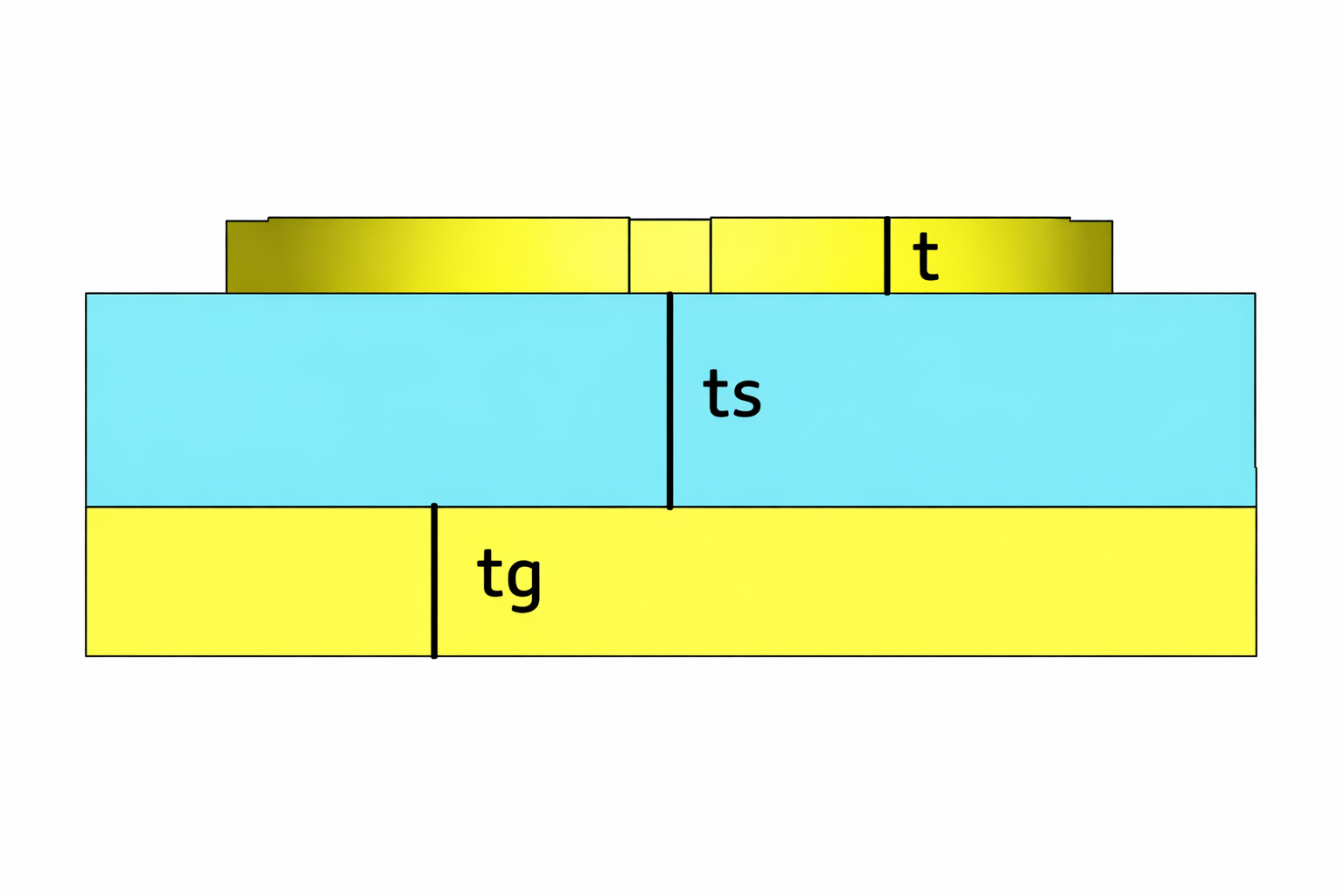
The proposed absorber uses a DSRR printed above a dielectric spacer and continuous silver ground plane. The ground suppresses transmission, while the split-ring geometry produces LC resonances and confines electromagnetic energy. Instead of rebuilding the topology for every operating point, the resonator dimensions are systematically scaled to tune the response.
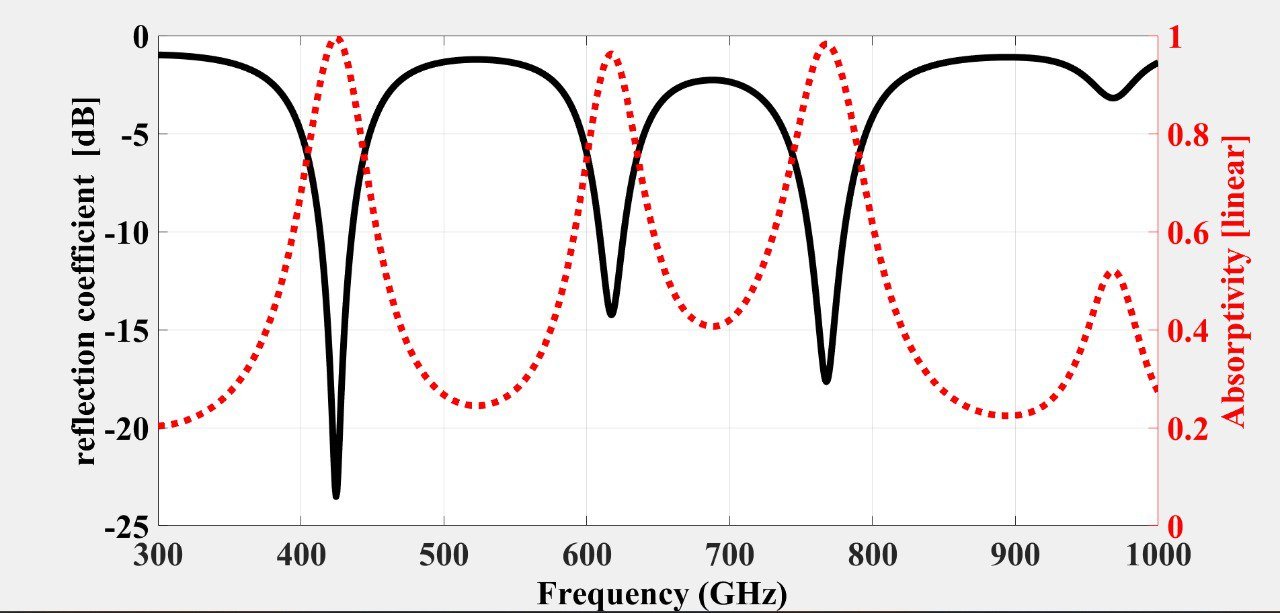
The study reports designed resonances at 423, 518, 640 and 831 THz, with absorption approaching unity at the target resonances.
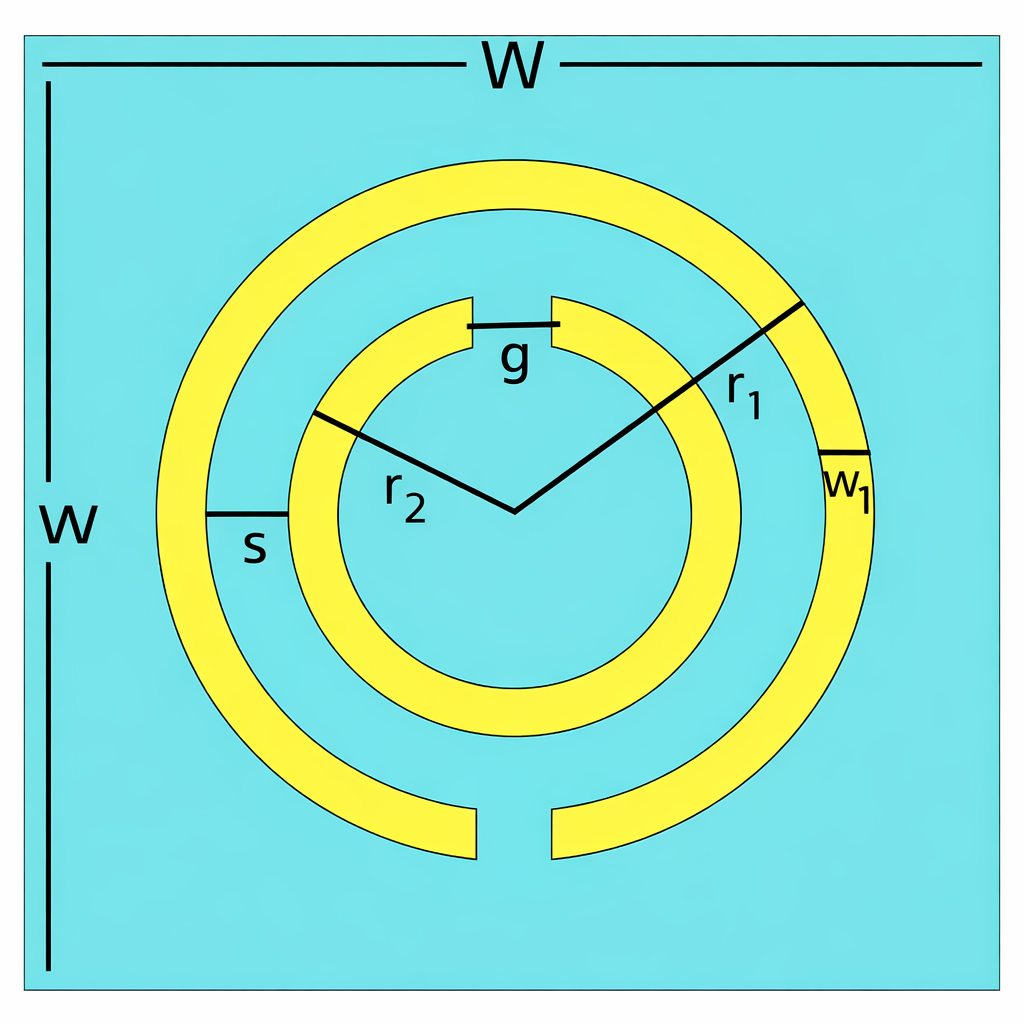
Select one of the four designs to see the actual dimensions reported in the thesis. The live model rescales the concentric DSRR geometry and animates incident optical energy toward the absorber.
The spacer and ground thicknesses remain fixed while the lateral DSRR geometry is scaled. The 831 THz case keeps W at 288 nm while using the smaller ring dimensions reported for the high-frequency design.
| Parameter | 423 THz | 518 THz | 640 THz | 831 THz |
|---|---|---|---|---|
| W (nm) | 288 | 230.4 | 180 | 288 |
| r₁ (nm) | 128 | 102.4 | 80 | 80 |
| r₂ (nm) | 80 | 64 | 50 | 50 |
| w₁ (nm) | 16 | 12.8 | 10 | 10 |
| g₁ (nm) | 32 | 25.6 | 20 | 20 |
| s (nm) | 32 | 25.6 | 20 | 20 |
| t (nm) | 32 | 25.6 | 20 | 20 |
| ts (nm) | 60 | 60 | 60 | 60 |
| tg (nm) | 40 | 40 | 40 | 40 |
With the metallic ground plane making transmission approximately zero, absorptivity is evaluated from the reflection response. The simulated curves show deep S11 minima at the designed resonances and absorption approaching 100%.
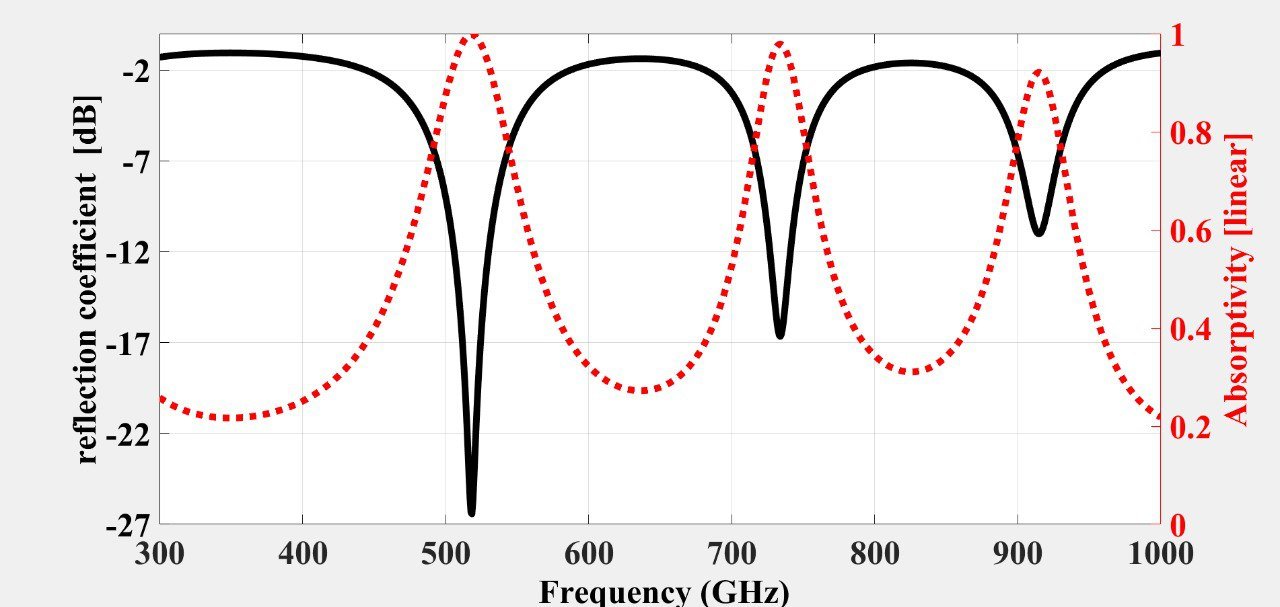
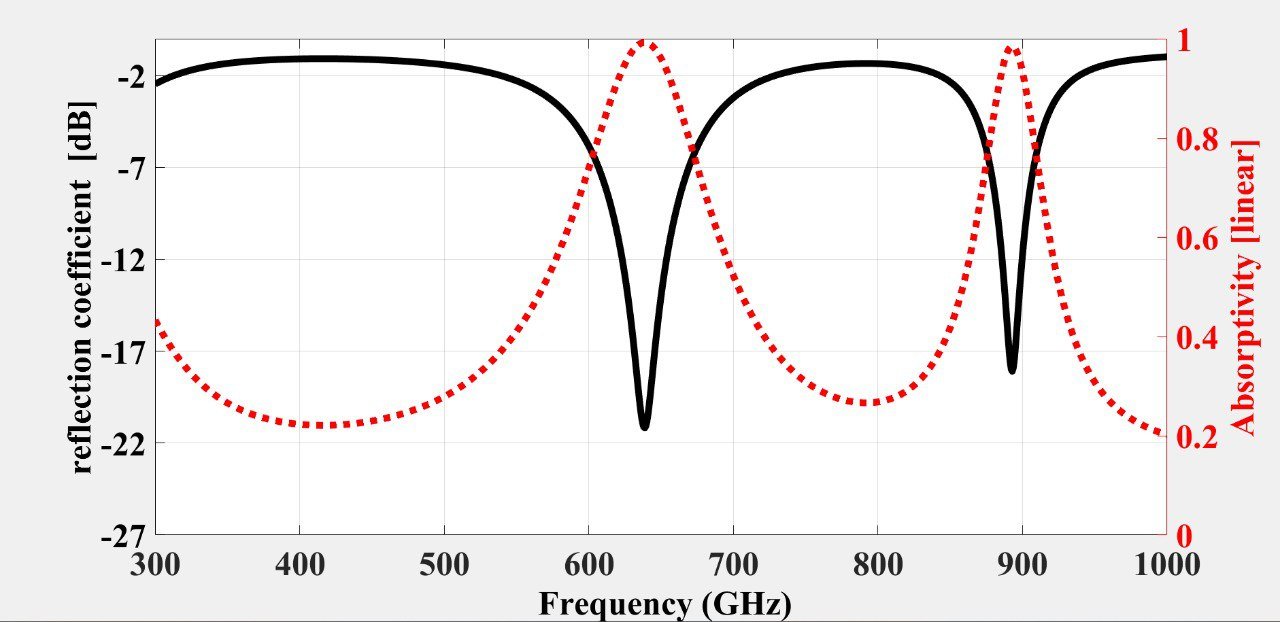
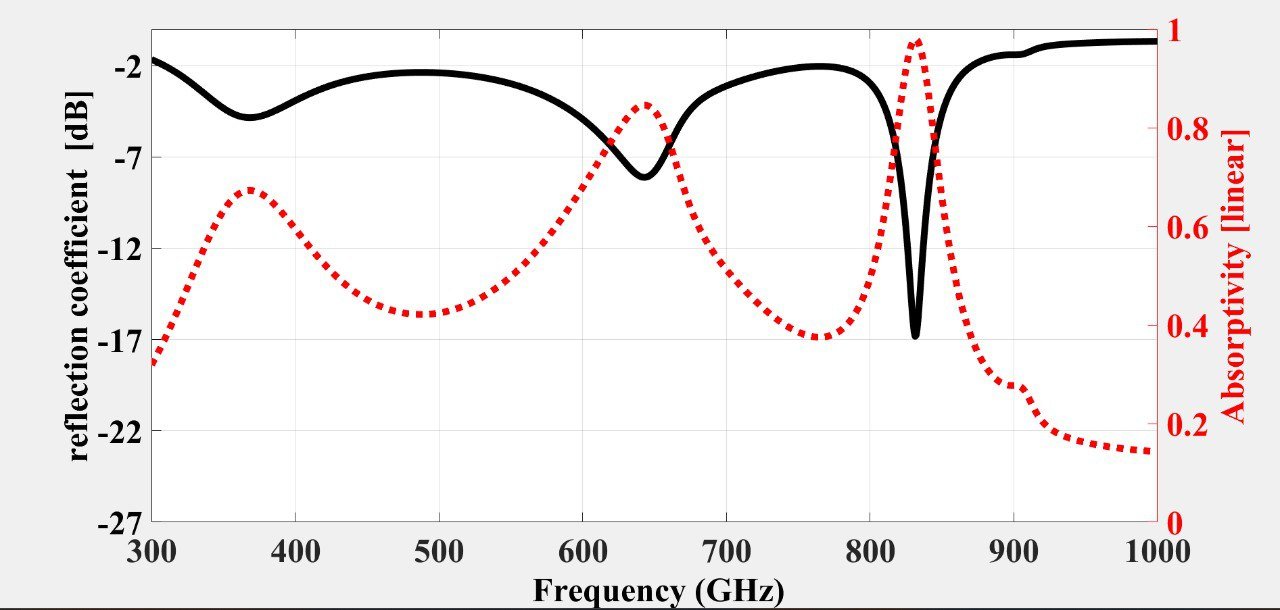
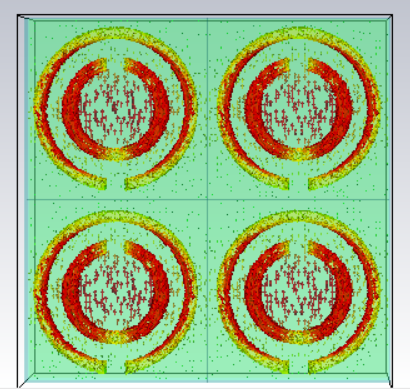
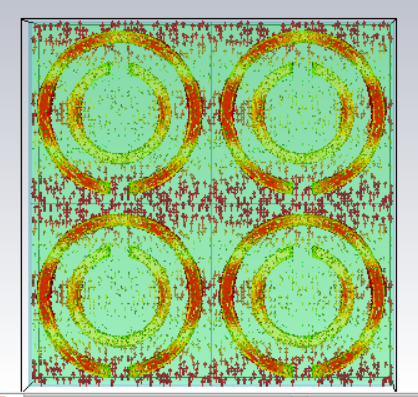
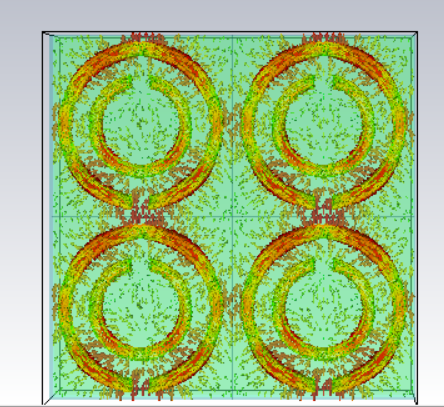
Current concentration around the split rings confirms the resonant behavior. The lower-frequency design also supports higher-order modes produced by the ring structure and coupling between the inner and outer resonators.
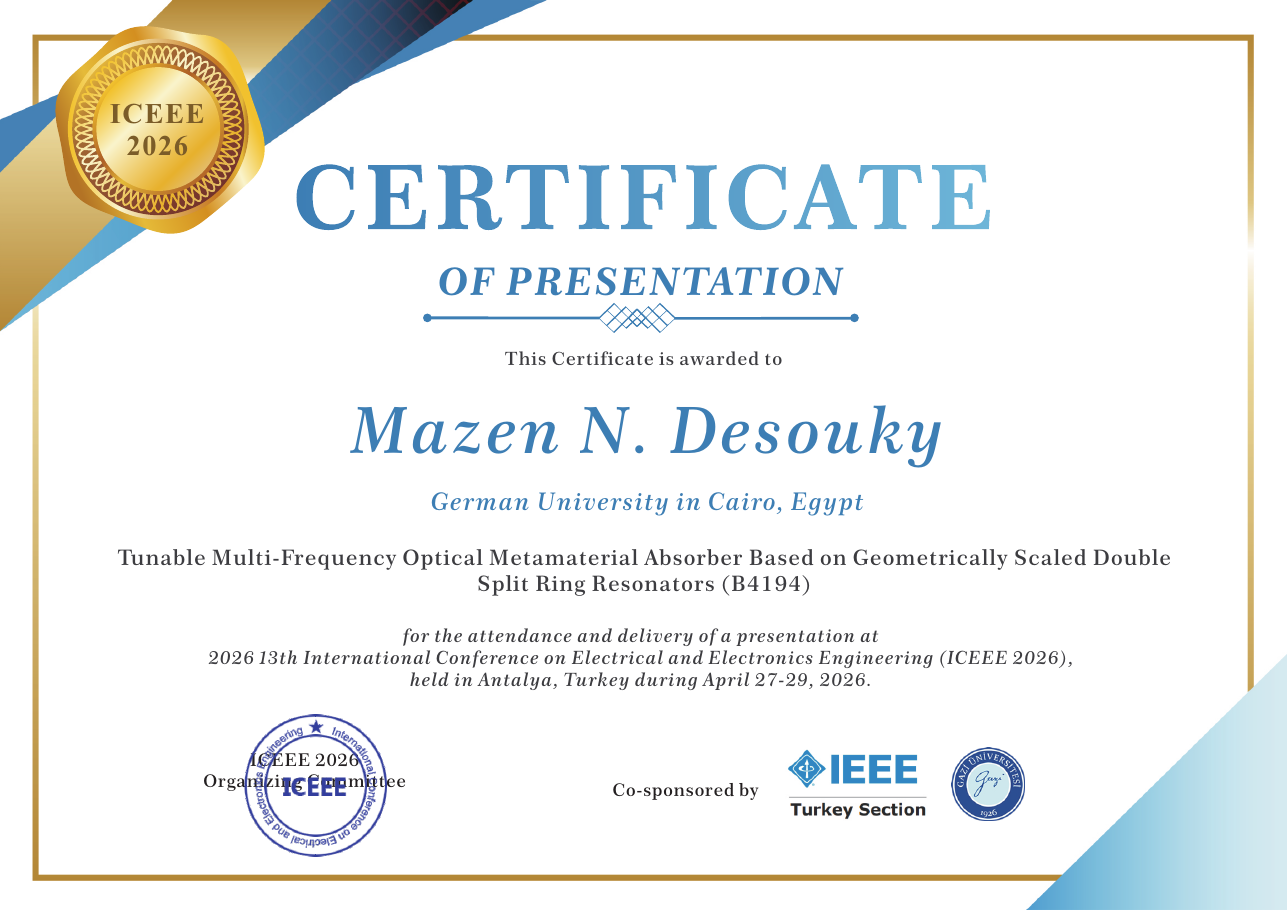
The work was formally invited for in-person presentation at the 13th International Conference on Electrical and Electronics Engineering (ICEEE 2026), held in Antalya, Turkey, April 27–29, 2026. The certificate records the delivery of the presentation under paper ID B4194.
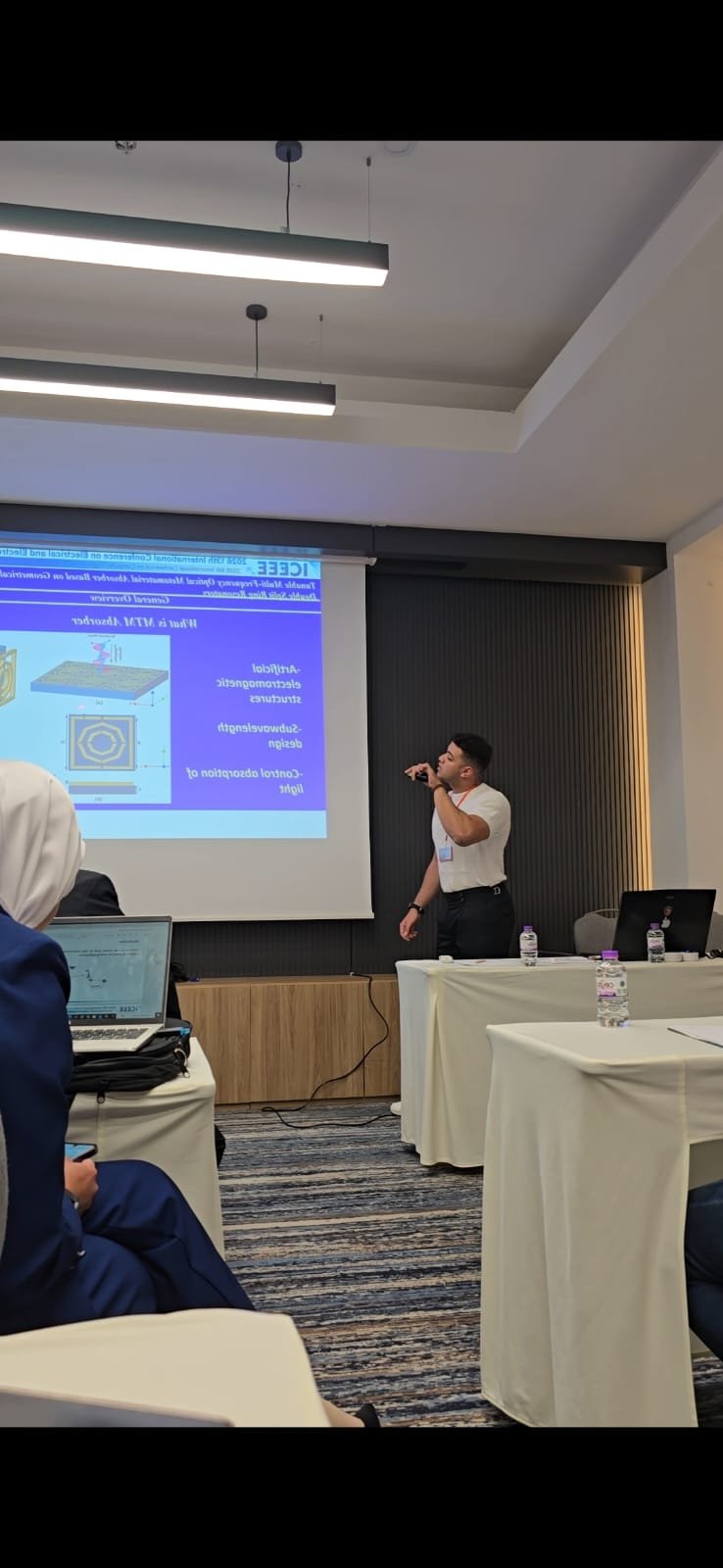


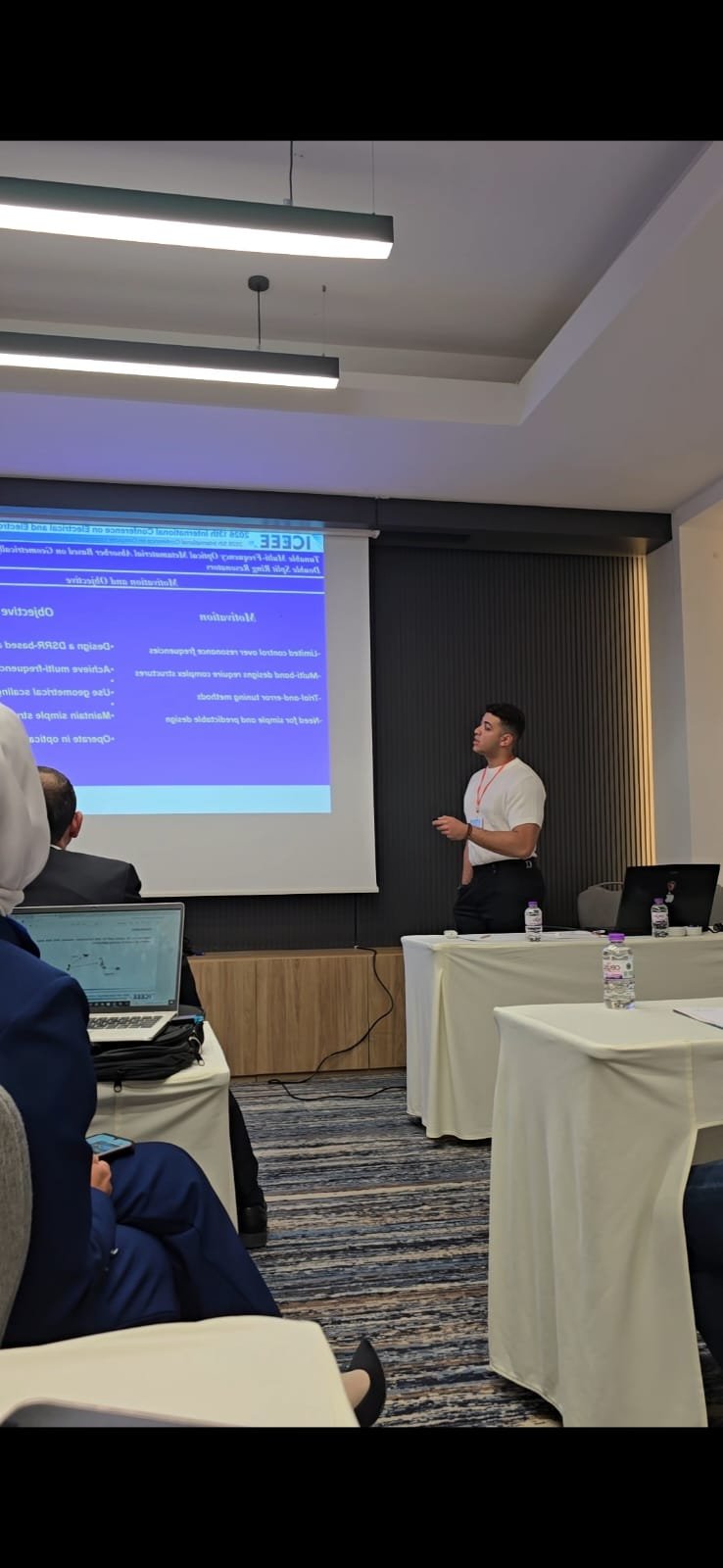
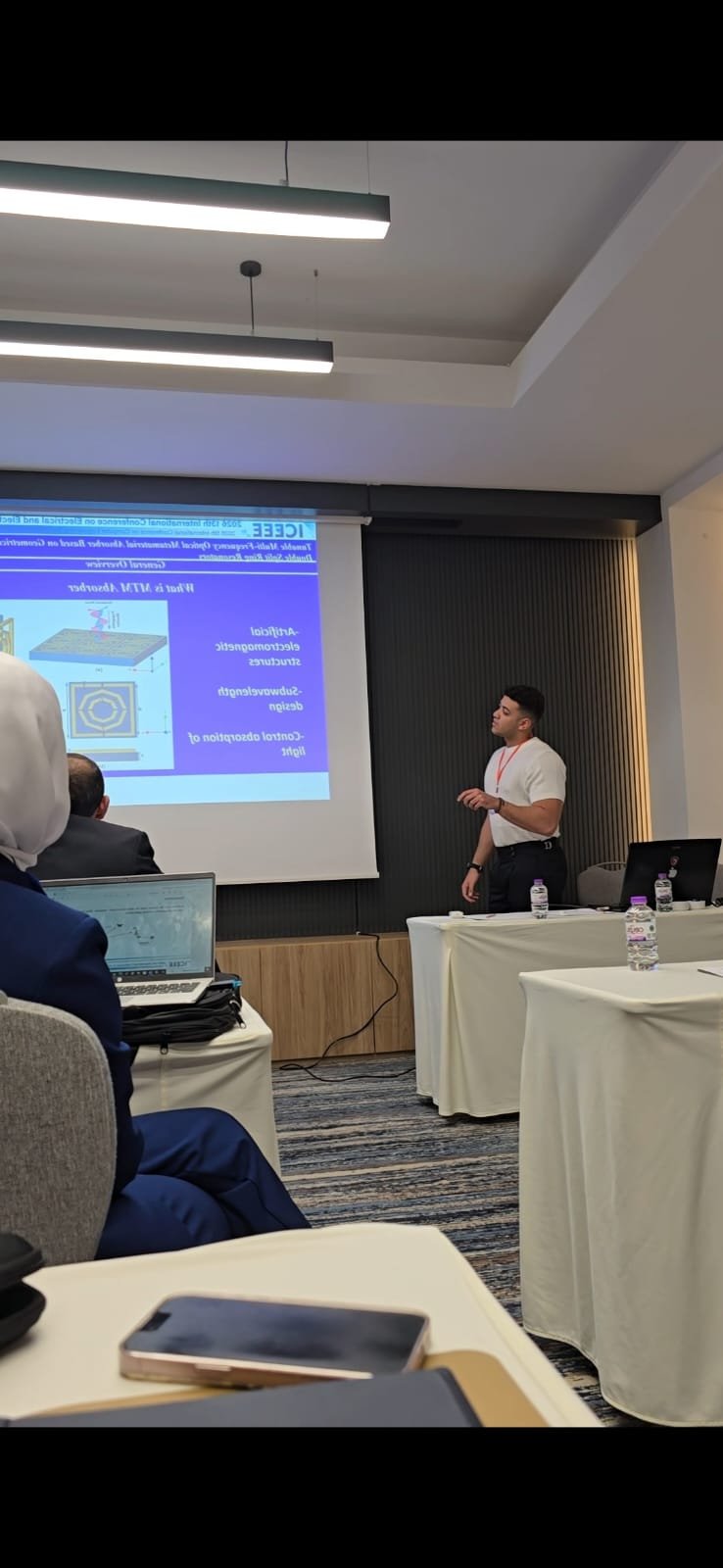

The invitation names the research work and invites its in-person presentation in Antalya. The certificate confirms attendance and delivery of the presentation.
A bachelor thesis spanning resonator design, CST/FDTD simulation, S-parameter analysis, surface-current interpretation and conference presentation.
Microwave-based electromagnetic diagnosis research investigating how malignant tissue changes the electromagnetic response of a breast model for early-stage detection.
Malignant and healthy breast tissues exhibit different dielectric behavior. The research explores whether those contrasts can produce a measurable change in an antenna's electromagnetic response.
The engineering challenge is to build a controlled numerical environment in which the tissue model, excitation and resulting response can be compared systematically.
Construct the breast phantom and define the anatomical tissue regions.
Assign dielectric properties representing the electromagnetic behavior of each tissue.
Position the antenna and illuminate the model with the selected microwave signal.
Evaluate healthy and malignant cases through S-parameters and field behavior.
The simulation is organized as a layered biomedical electromagnetic model. Each region can be assigned its own material definition, allowing the malignant inclusion to be studied against surrounding healthy tissue.
Baseline antenna and field response of the tissue model.
Dielectric contrast perturbs the local field and measurable electromagnetic response.
Track changes in reflection behavior between reference and malignant models.
Visualize electromagnetic concentration and perturbation through the tissue volume.
Study the localized response associated with the malignant inclusion.
Portfolio visualization — numerical values and final plots can be replaced with the verified CST results from the research model.
By combining antenna engineering, tissue electromagnetics and full-wave simulation, the work investigates microwave sensing as a non-ionizing research approach for detecting dielectric abnormalities associated with early-stage breast cancer.
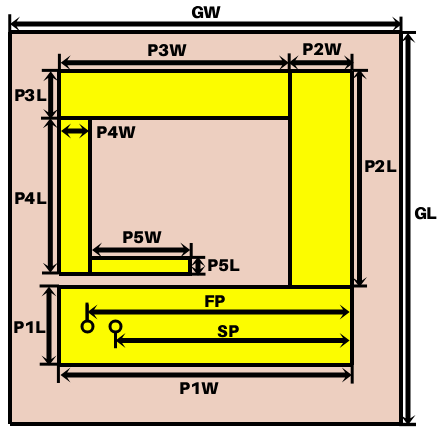
A compact rectangular spiral antenna was designed, fabricated and investigated as an electromagnetic sensor for early-stage breast-cancer diagnosis. The study tracks how malignant tissue changes the antenna's resonant response when the sensor is placed directly on a multilayer breast phantom.
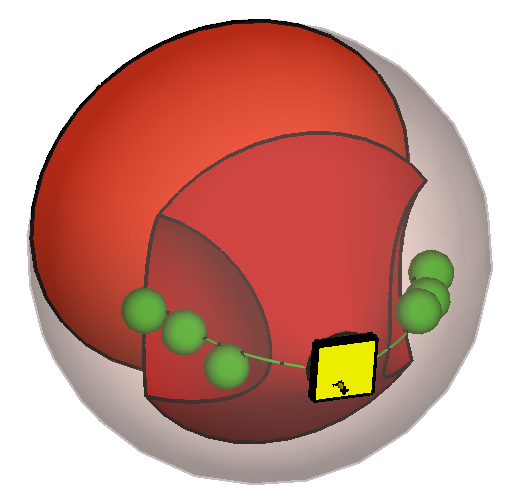
Healthy and malignant breast tissues do not interact with electromagnetic fields in the same way. Their different dielectric properties alter the electromagnetic loading seen by an antenna placed on the breast. This work uses that change as the sensing mechanism: keep the antenna and phantom configuration controlled, introduce early-stage tumor scenarios, and observe the shift in resonance and impedance matching.
The goal is not to create an anatomical image from MRI data. There is no BrainWeb, 3D Slicer or MeshLab workflow here. The breast phantom is a purpose-built electromagnetic model, simulated in CST; MATLAB is used in the analysis workflow, and the fabricated antenna is validated experimentally with a Rohde & Schwarz ZVB20 Vector Network Analyzer.
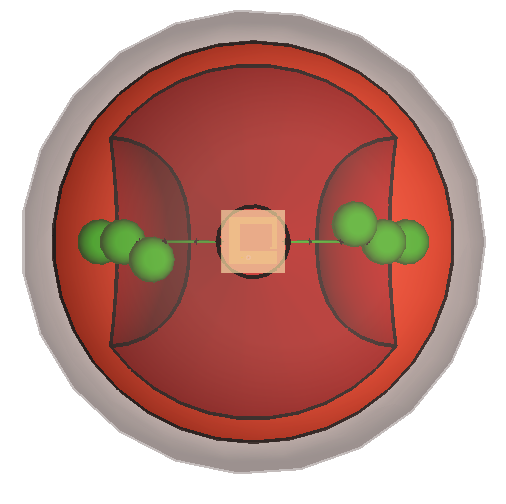
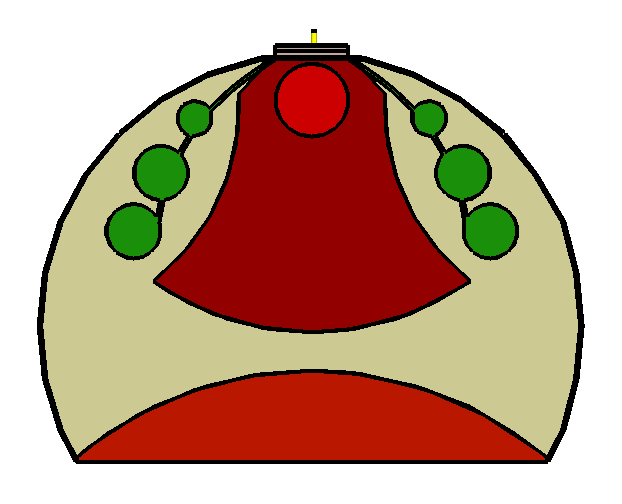
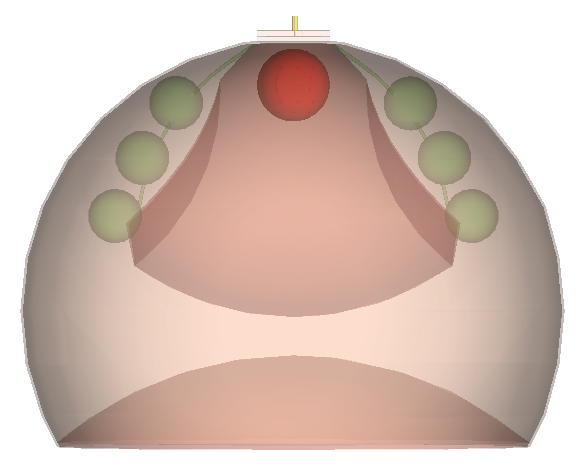
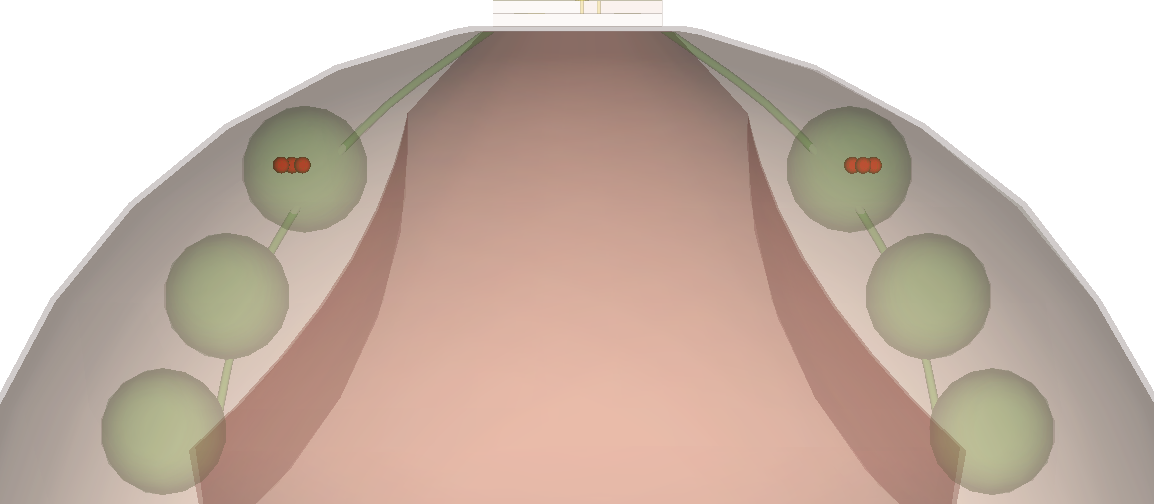
The phantom is a simplified hemispherical breast with a 75 mm radius. It includes skin, fat and muscle as the principal layers, while fibro-glandular tissue and lymph nodes are embedded inside the fat region. Three lymph nodes are modeled on each side of the fibro-glandular region, with ducts also represented. A flattened area at the nipple provides a repeatable mounting surface for the antenna.
This geometry allows the same sensor position to be maintained while tumor size and location are varied—so the resulting S11 changes can be compared against a healthy baseline.
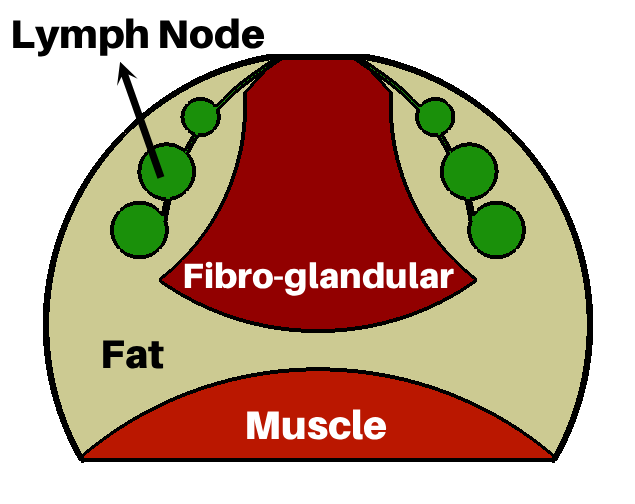
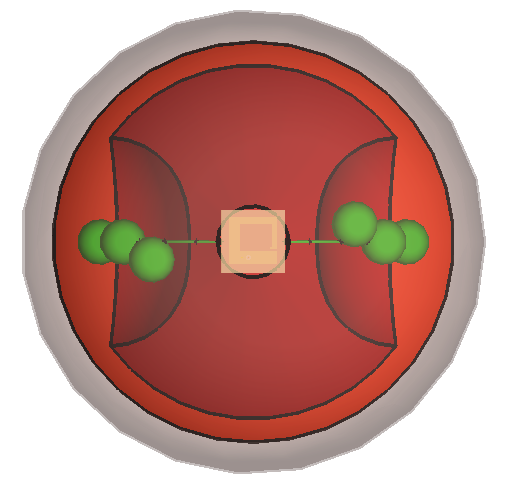
The model explicitly separates tissue types by relative permittivity, conductivity and density. That contrast is fundamental to the sensing principle.
| Tissue | εr | σ (S/m) | ρ (kg/m³) |
|---|---|---|---|
| Skin | 37.9735 | 1.478 | 1100 |
| Fat | 5.14085 | 0.139 | 920 |
| Fibro-glandular | 57.2 | 1.99 | 1050 |
| Muscle | 52.668 | 1.773 | 1060 |
| Lymph node | 78 | 0.965 | 1050 |
| Tumor | 46.1 | 0.68 | 1050 |
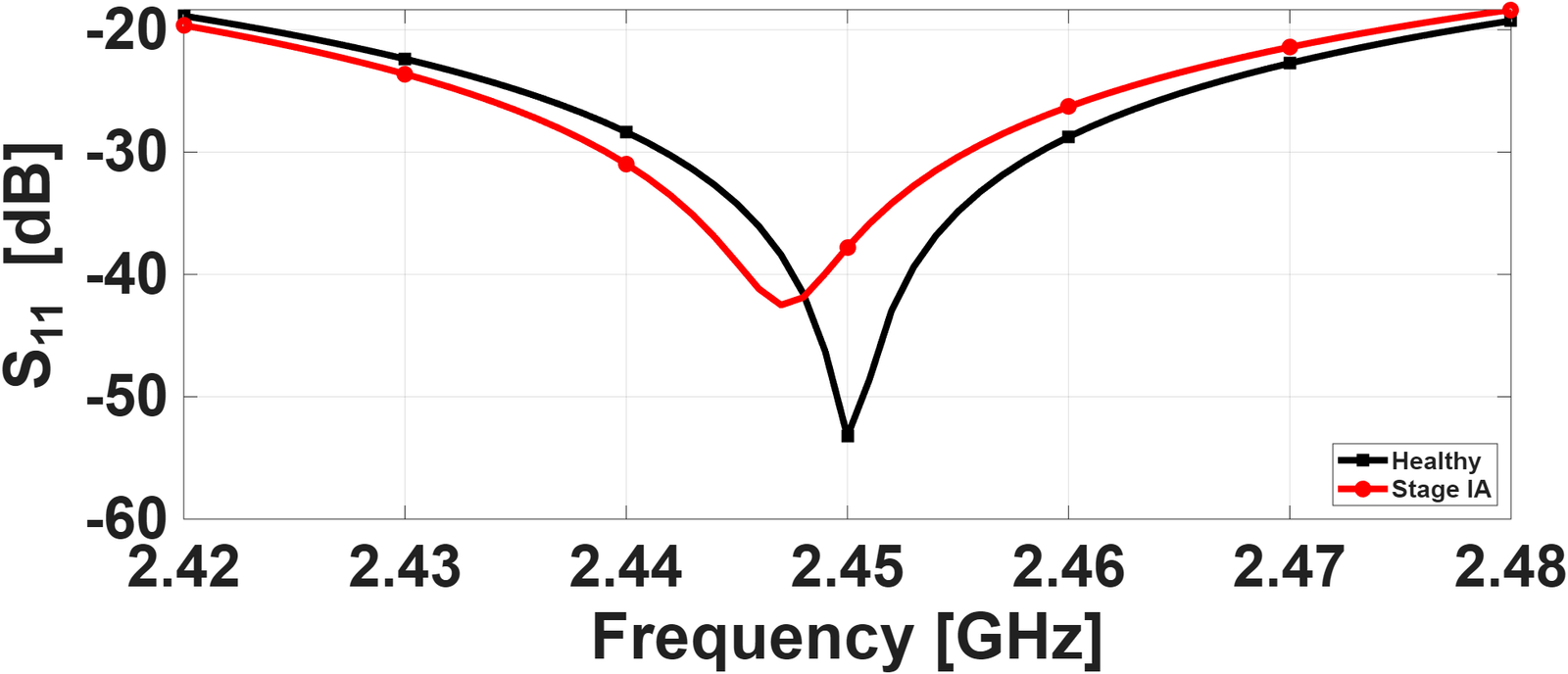
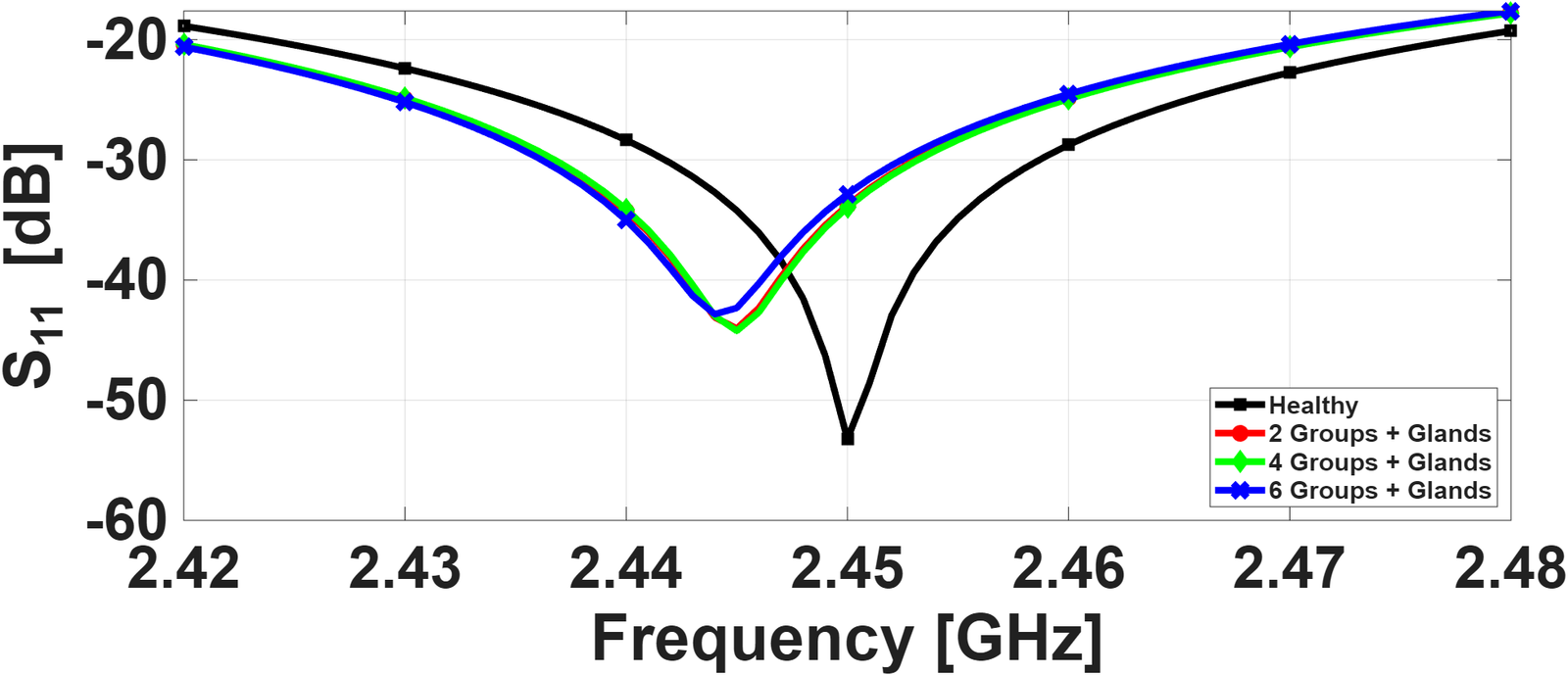
Stage IA is represented by a single tumor in the fibro-glandular region. Stage IB extends the investigation to lymph-node involvement: 2, 4 and 6 lymph-node groups are tested, both with and without an additional fibro-glandular tumor. Each scenario is compared to the same healthy breast response.
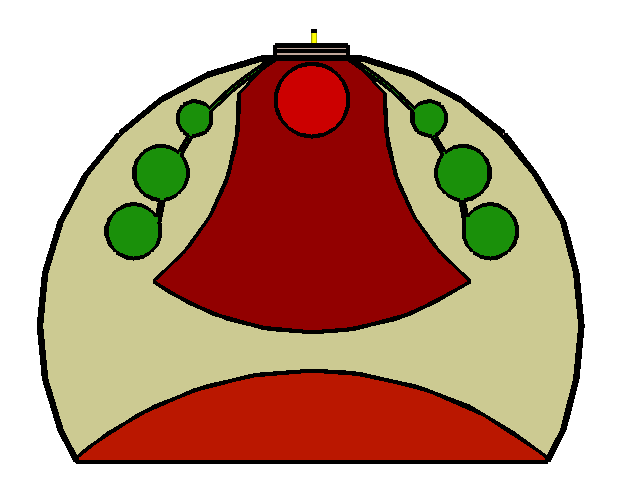
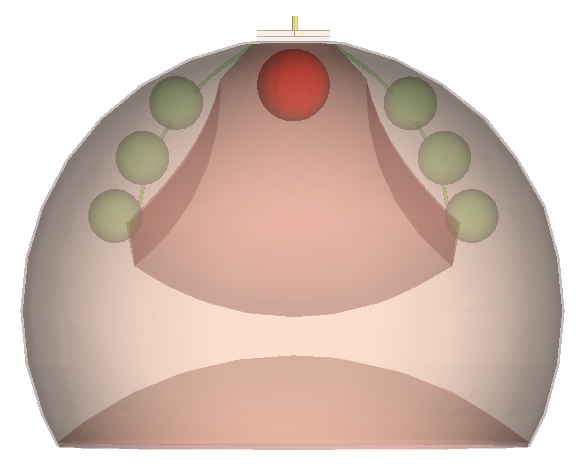
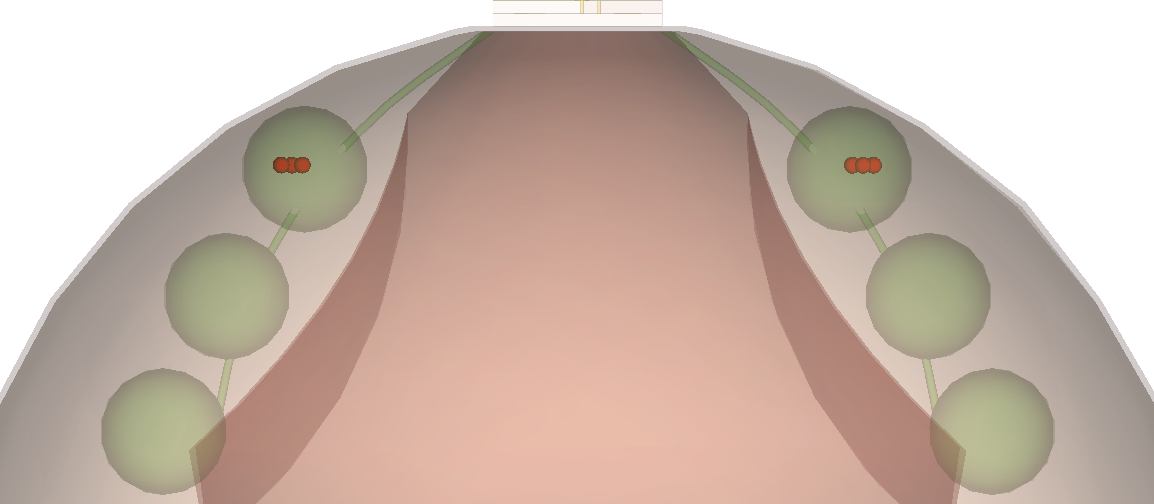

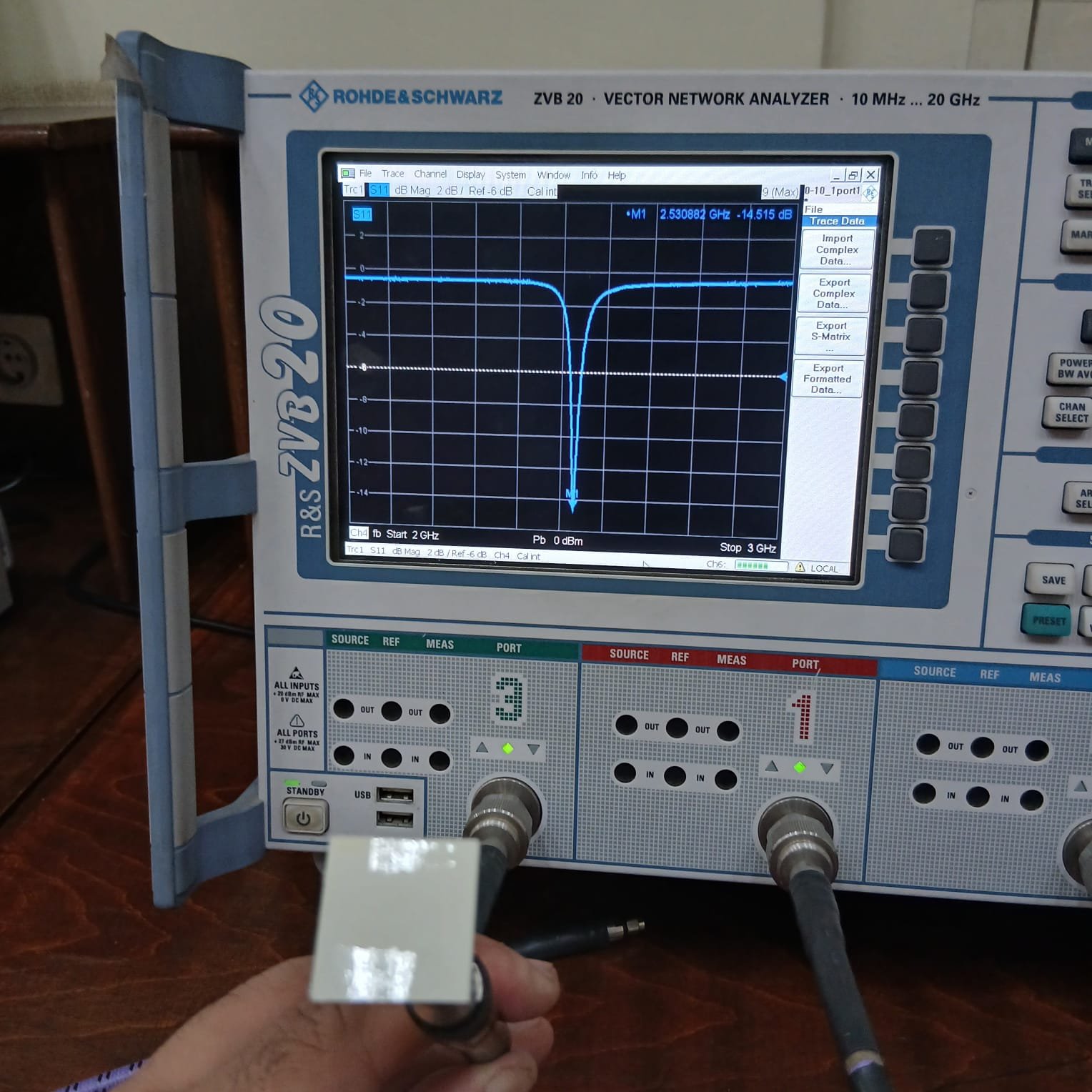
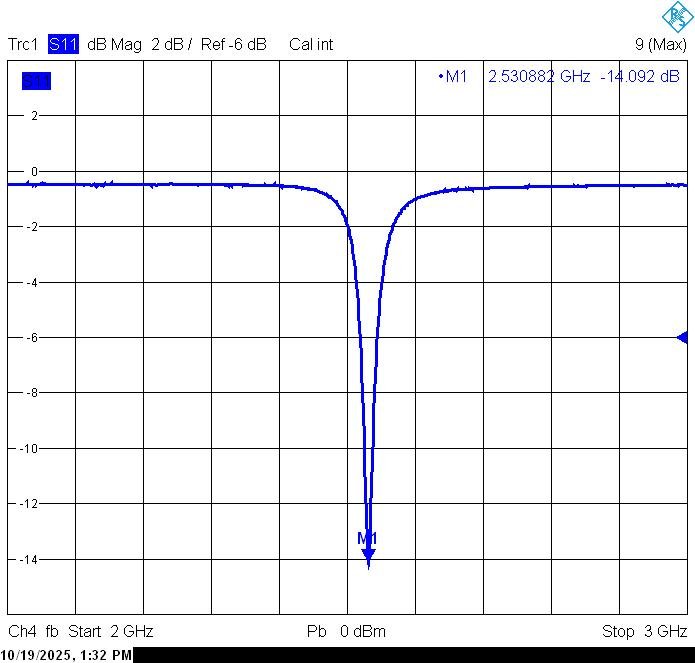
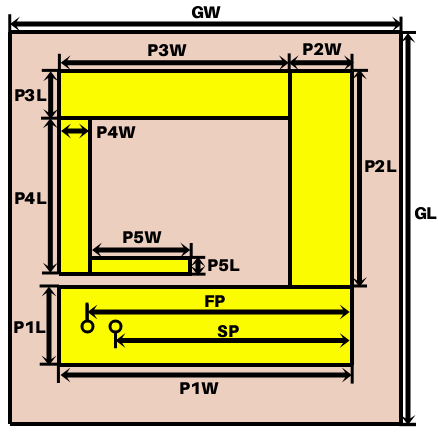
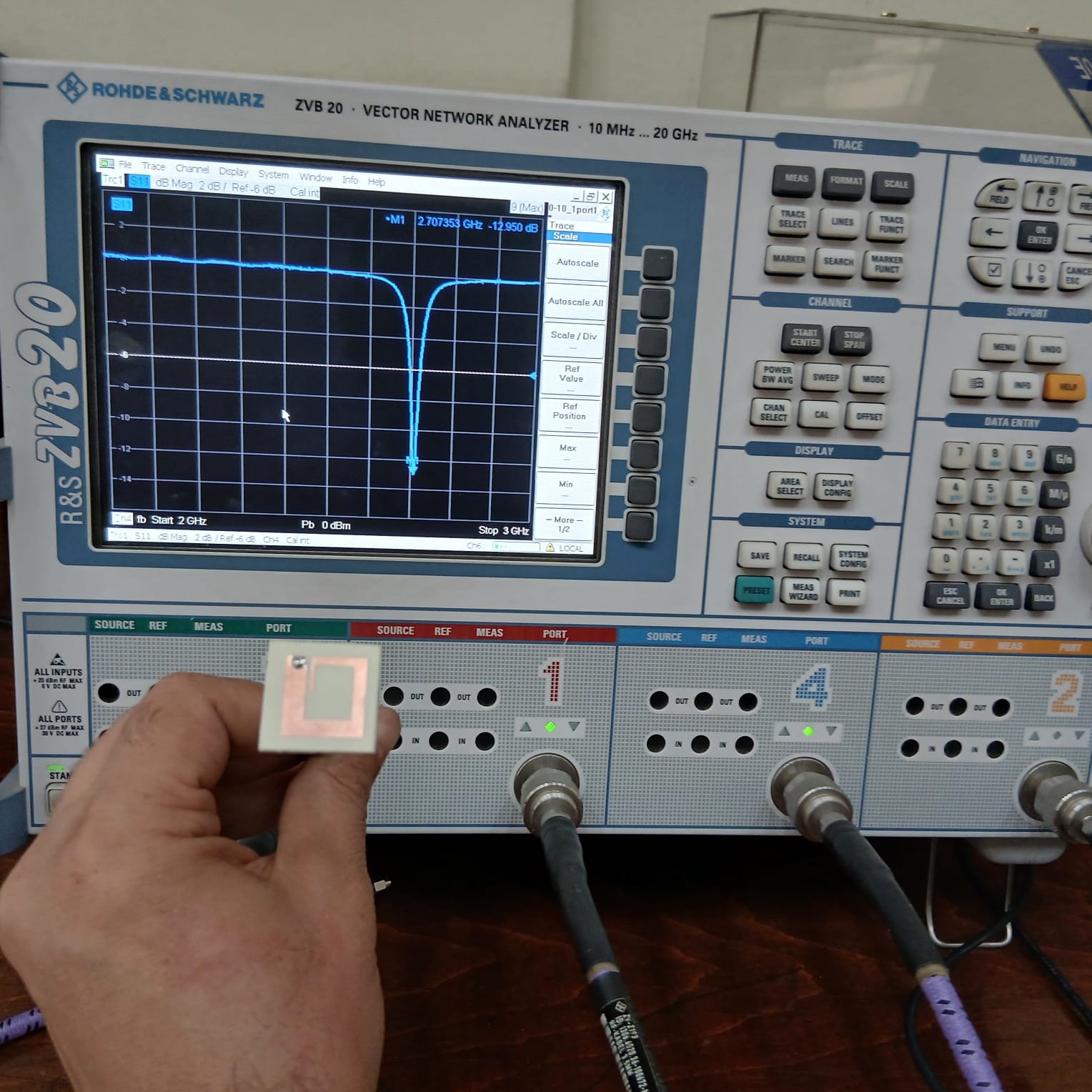
The sensor is not only a simulation. The rectangular spiral antenna was physically fabricated and characterized using a Rohde & Schwarz ZVB20 Vector Network Analyzer. The antenna uses annealed copper on Rogers 4350B, with a matching superstrate for protection and stability, and a 50 Ω coaxial feed.
The design targets the 2.4–2.5 GHz ISM band. Measurement provides a reality check against the simulated antenna response before the sensor is used as the diagnostic element in the breast-phantom study.
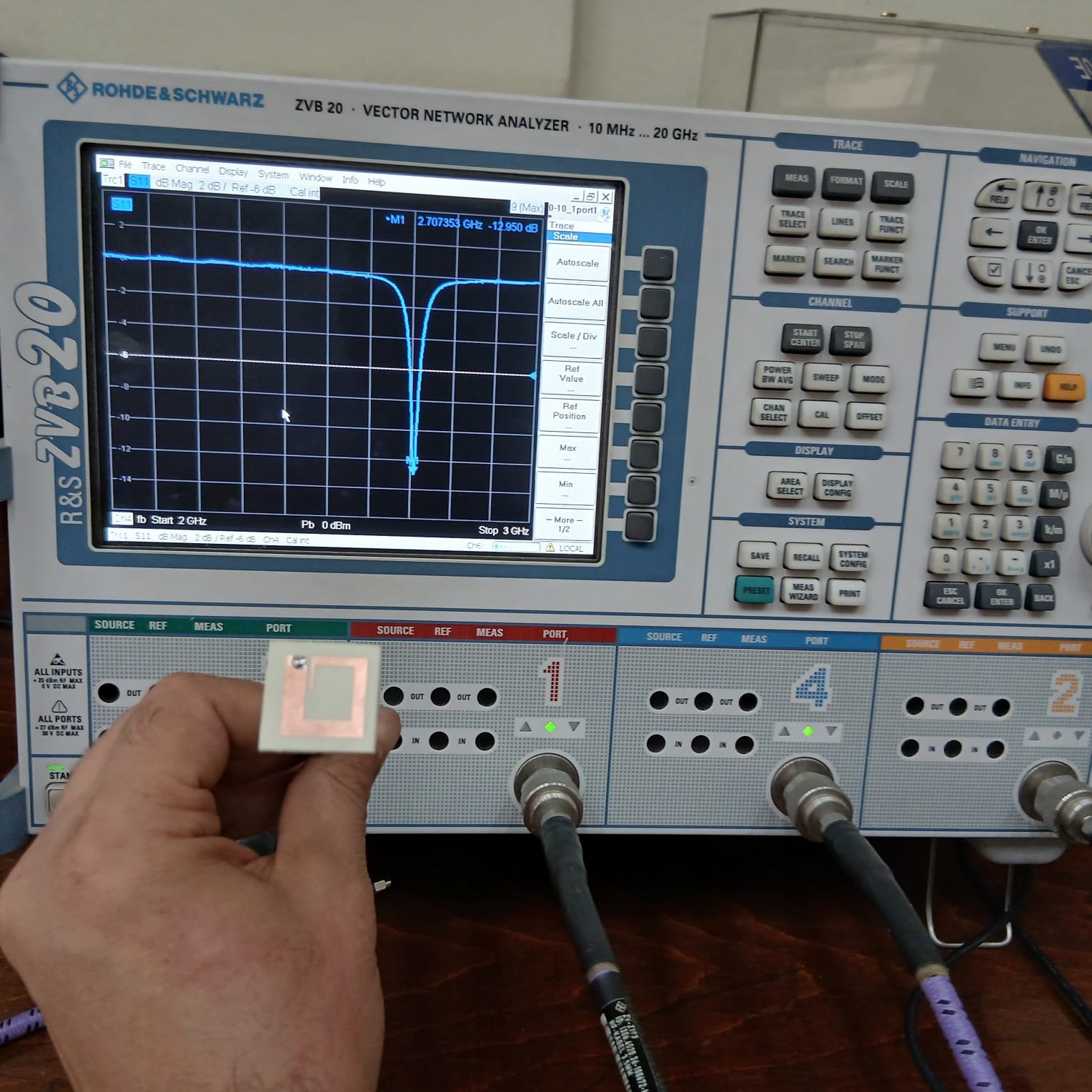
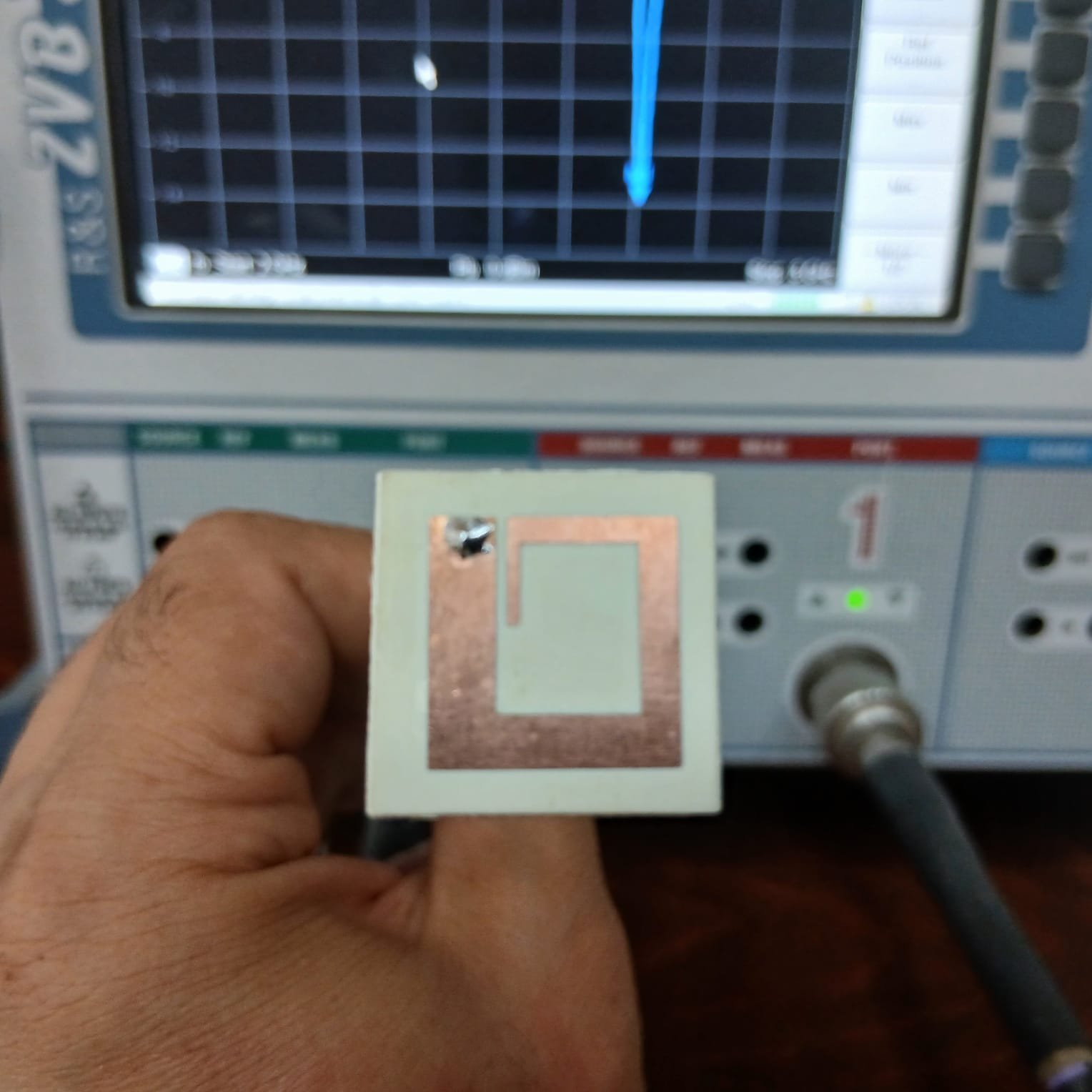
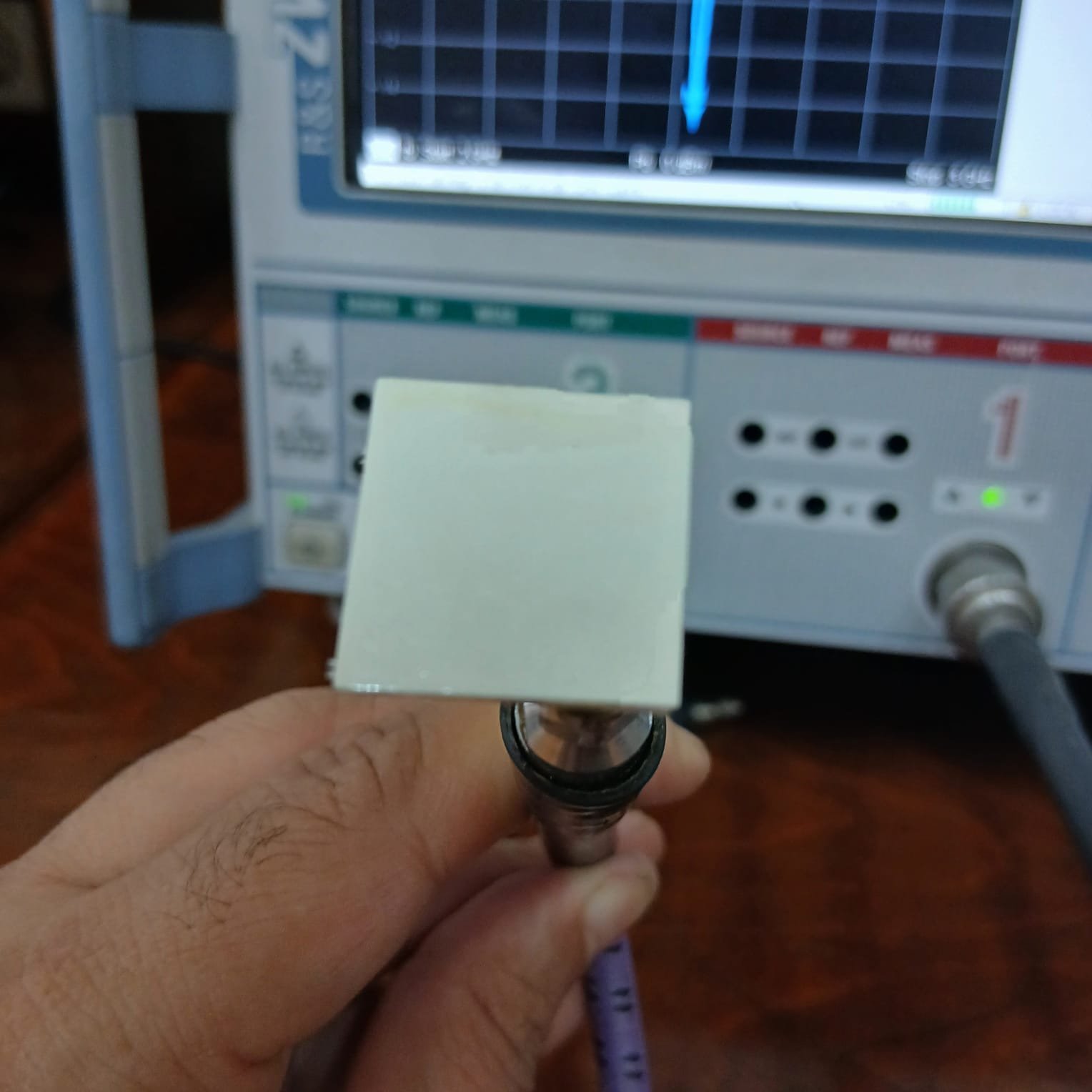
The planar spiral was selected for compact size and straightforward fabrication. In air, the design is optimized for good impedance matching in the ISM band. When mounted on the breast, the arm length and feed/shorting positions are retuned to compensate for the strong dielectric loading of tissue.

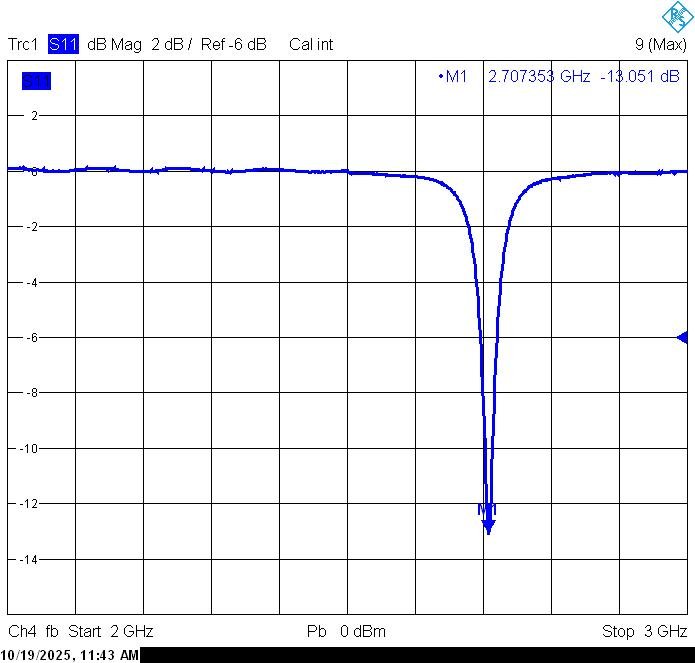
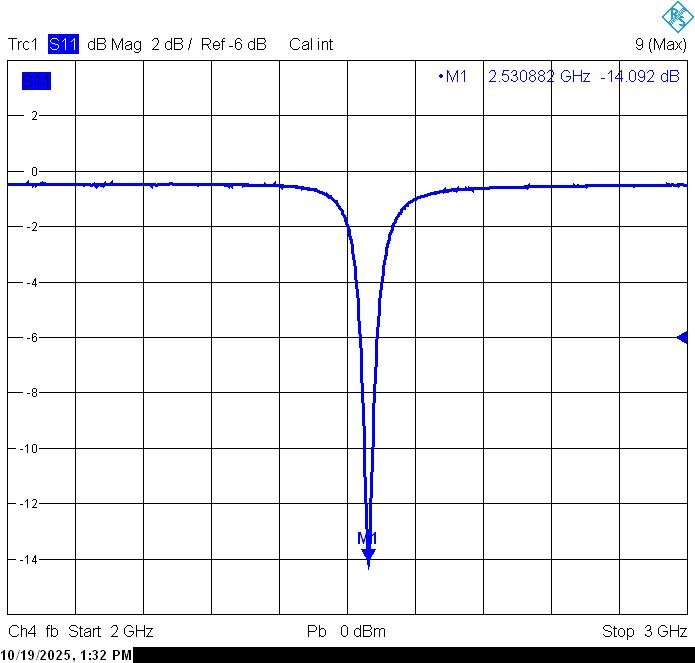
The fabricated antenna confirms a clear resonance in measurement. In the breast model, the healthy case resonates at 2.4500 GHz. Introducing the Stage IA tumor moves the resonance to 2.4470 GHz—a 3 MHz downward shift. Stage IB scenarios also remain below the healthy resonance, with shifts that depend on the number and location of tumors.


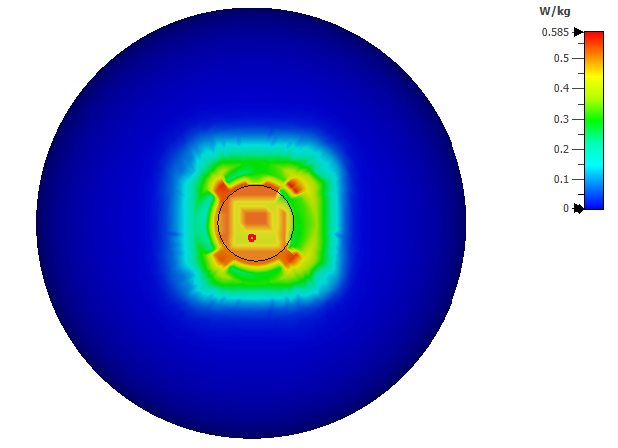
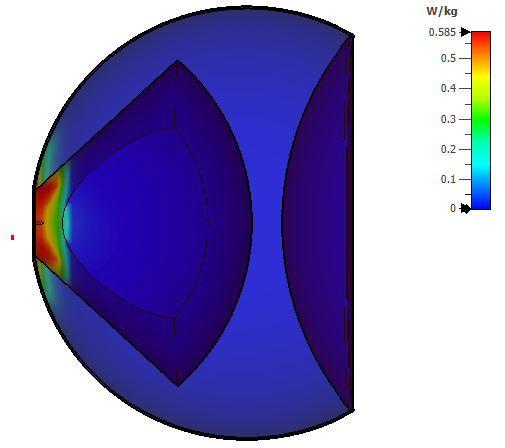
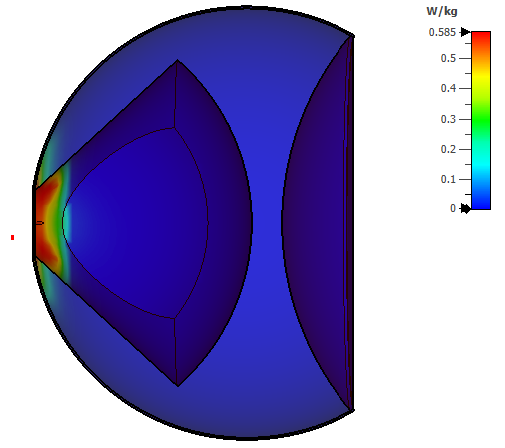
With the antenna implanted on the breast model, SAR was evaluated at 2.45 GHz and averaged over 10 g of tissue. The reported absolute maximum is 0.585 W/kg, concentrated near the antenna placement.
Design the rectangular spiral sensor and tune it for the 2.4–2.5 GHz ISM band.
Build the hemispherical tissue model, assign dielectric properties, lymph nodes, ducts and tumor scenarios.
Process and compare response data, inspect resonance movement, and prepare quantitative result visualizations.
Fabricate the sensor and measure S11 experimentally to validate the physical antenna response.
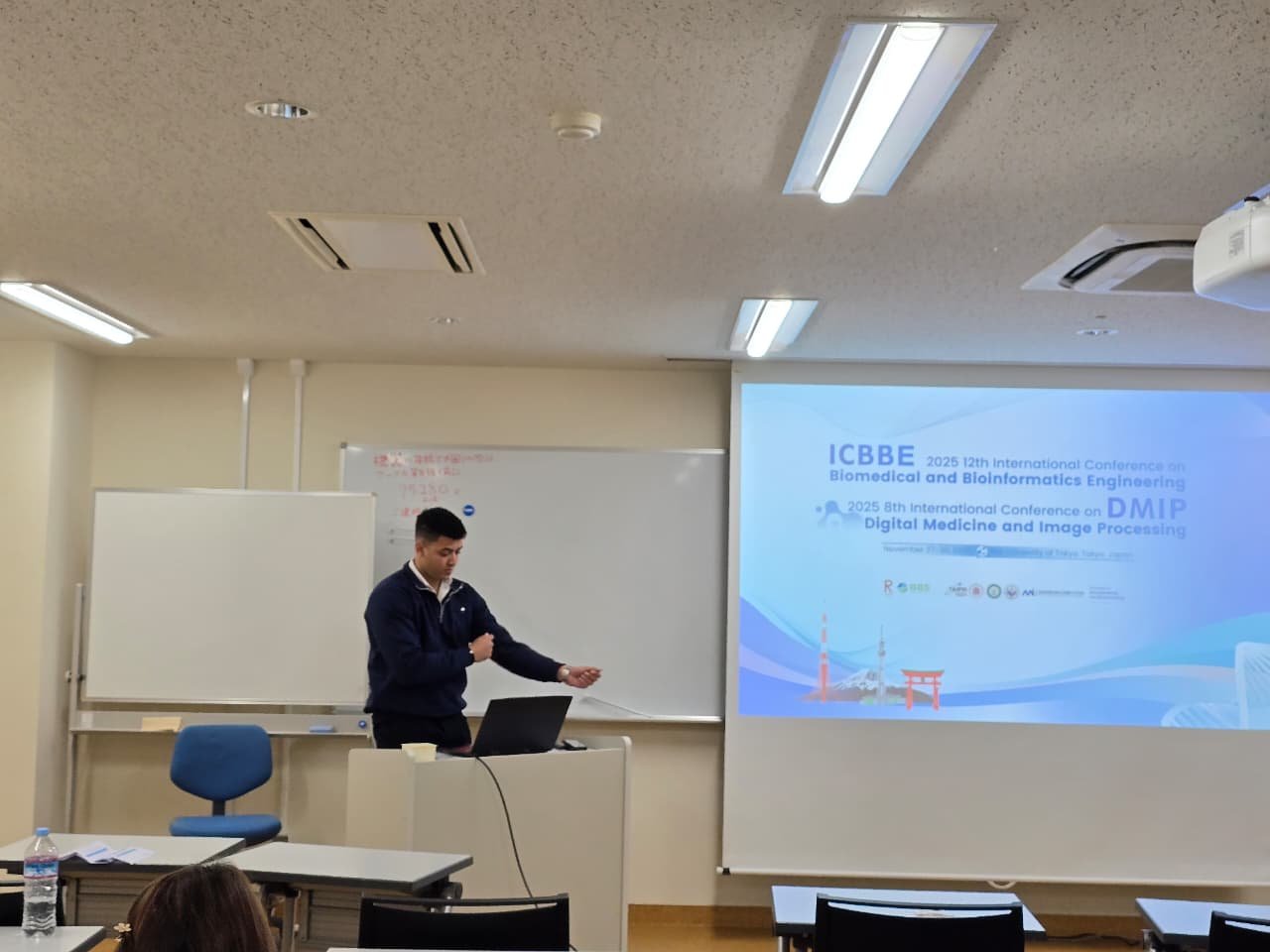
The work was presented at the 2025 8th International Conference on Digital Medicine and Image Processing (DMIP '25) in Tokyo. The presentation brought the antenna design, phantom methodology, tumor scenarios and measured/simulated electromagnetic response into a single research story.
Authors: Ismaeel M. Awad · Aya M. Hakik · Mohamad H. M. Hassanin · Pierre Louka · Mazen Nabil Desouky · Prof. Dr. A. M. M. A. Allam
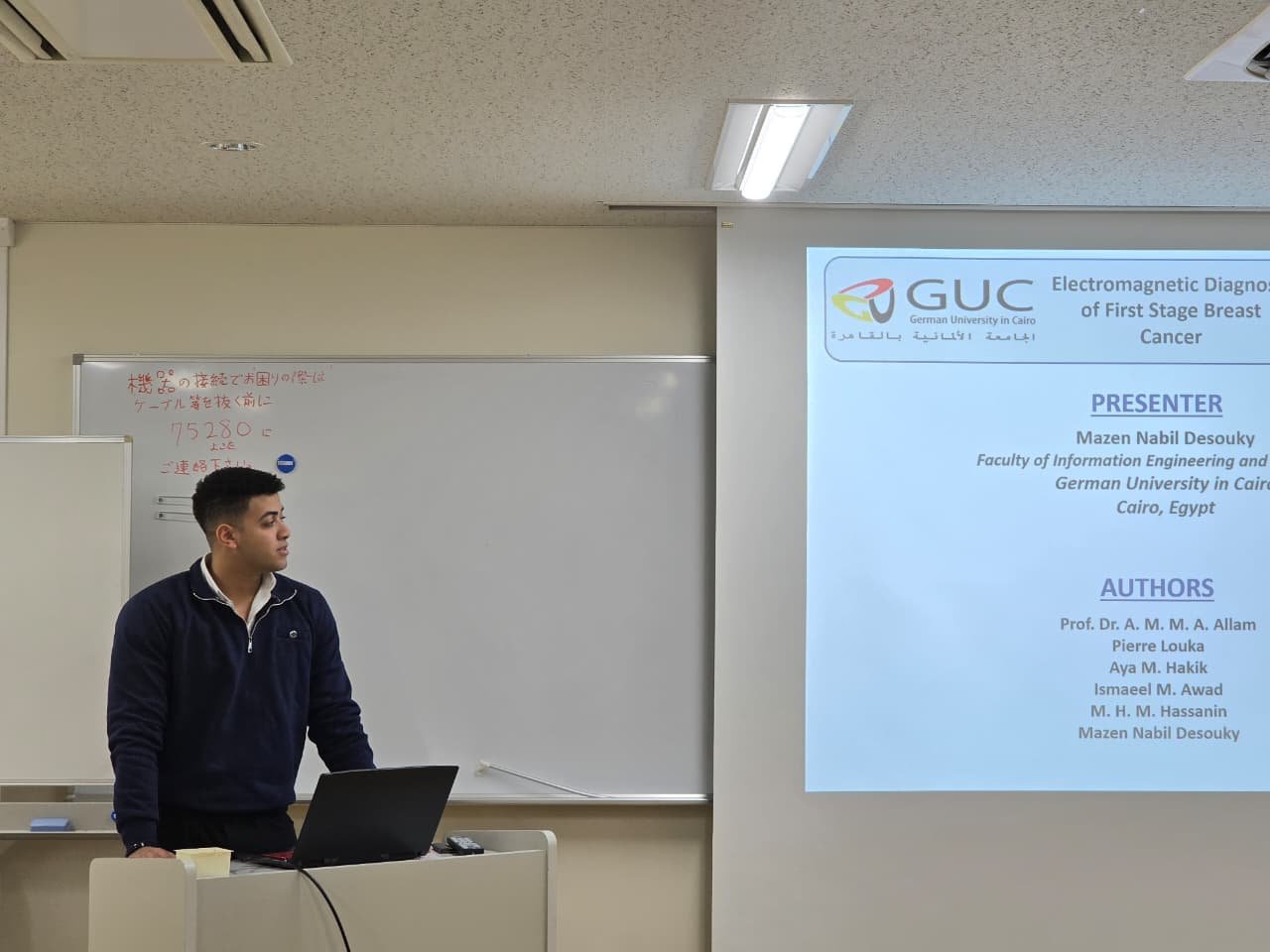
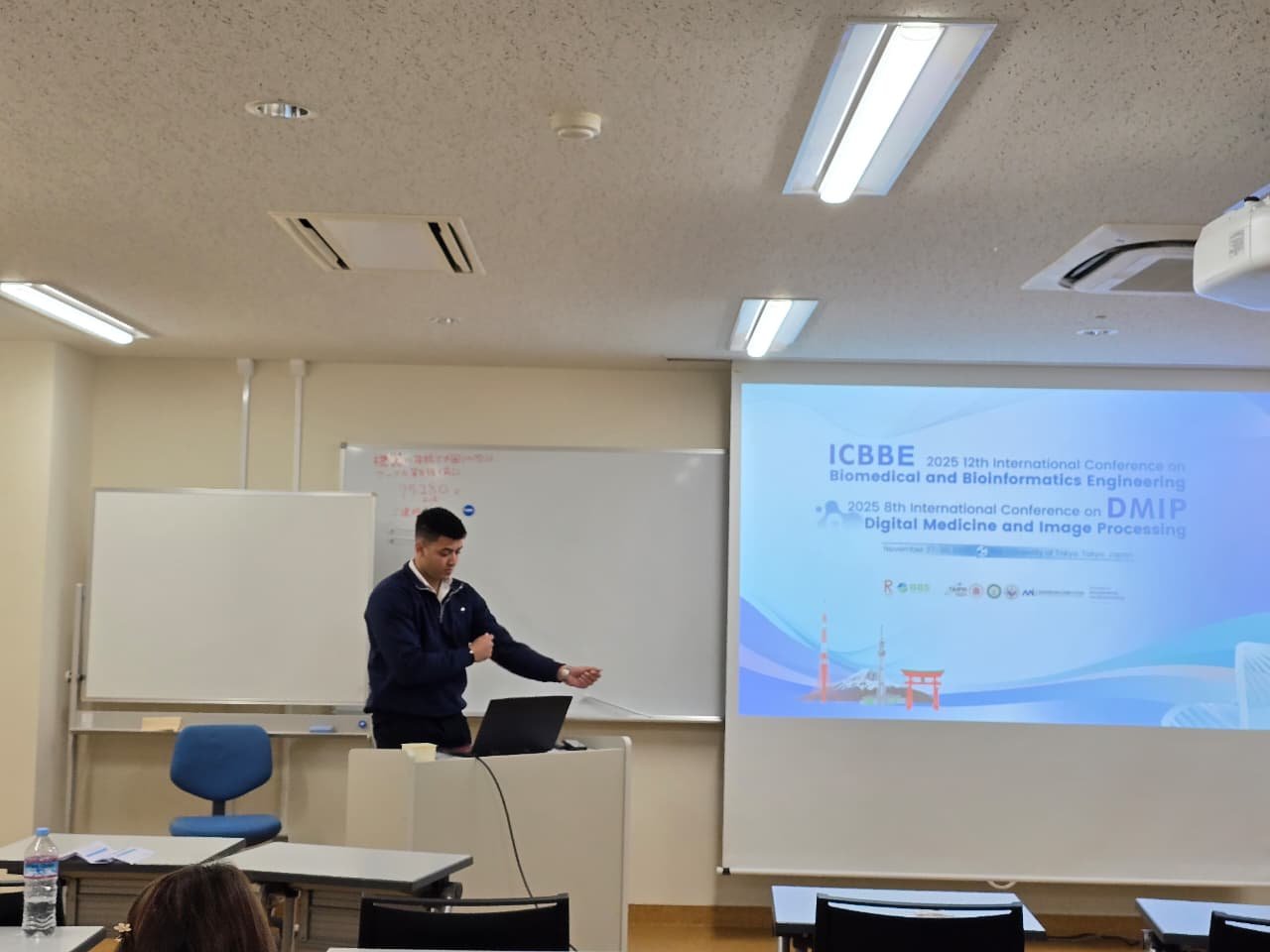
The complete research paper and its GUC undergraduate-research cover page are available directly from this portfolio.
A research journey spanning electromagnetic modeling, antenna engineering, physical fabrication, VNA measurement, MATLAB analysis and international presentation.
Electromagnetic investigation of early-stage brain tumor detection using a UWB antenna and a realistic multilayer head phantom.
Build a realistic electromagnetic simulation framework for studying how malignant tissue changes the microwave response of an anatomically representative head model.
This is not a pasted image. The model below is rendered as live HTML/CSS layers. Click any tissue to isolate it, inspect its role, and visually separate it from the neighboring tissues.
Explore the complete scalp-to-white-matter stack. Select a layer to isolate it and inspect how it fits into the electromagnetic head phantom.
Gray matter and white matter are aligned inside the pia and checked through X/Y/Z section views before simulation.
Imported anatomical structures are scaled and positioned so each inner structure remains fully contained by the surrounding model.
High-density anatomical surfaces are cleaned and reduced before CST import to keep the model practical for electromagnetic simulation.
Known values below come from the current project model. Unknown or still-changing values are intentionally not invented.
| Layer | Known Radius | εr | σ (S/m) | Model Role |
|---|---|---|---|---|
| Scalp | 90 mm | — | — | Outermost tissue |
| Fat | 88 mm | — | — | Subcutaneous layer |
| Periosteum | 85.5 mm | — | — | Skull interface |
| Skull | 85 mm | — | — | Bony layer |
| Dura | — | — | — | Meningeal layer |
| Arachnoid | — | 45 | 1.9 | Meningeal layer |
| CSF | — | — | — | Fluid layer |
| Pia | 75.45 mm | 45 | 1.7 | Inner meningeal layer |
| Gray Matter | Anatomical STL | — | — | BrainWeb geometry |
| White Matter | ~71.4 mm reference | — | — | Inner anatomical STL |
Patch radiator with narrow feedline, bent to conform to the head surface.
No intentional air gap between antenna and head model.
The project evolved through discrete-port and coaxial-feed configurations.
Inner coaxial radius value recorded in the current project configuration.
Introduced into the brain model to investigate tumor-induced electromagnetic response variations.
The portfolio uses your real CST S11 plots for the scientific comparison.
No value is fabricated here. Add the final tumor radius and coordinates once fixed.
Used after the frequency-domain workflow became computationally problematic for the full head model.
Reflection response and electromagnetic field behavior are key outputs of the investigation.
Spherical-coordinate references are used to track controlled antenna locations around the head.
The visual schematic follows the project's patch-and-feedline form and the bent placement used to maintain direct contact with the head surface.
Position is represented with spherical coordinates so controlled shifts around the head can be studied without changing the antenna design.
The investigation is built around controlled comparison. The antenna is integrated directly with the head model, the electromagnetic response is simulated, and the resulting S-parameters can be compared between model conditions.
Feed the antenna and establish the electromagnetic excitation used for the head-model investigation.
Observe how the radiated field interacts with the multilayer tissues rather than treating the head as a homogeneous object.
Introduce the tumor target inside the modeled brain region while preserving the surrounding geometry and antenna configuration.
Use the real CST S11 response to inspect changes in antenna behavior associated with the simulated model condition.
The scientific result panels below are populated only from the S11 screenshots you upload in WordPress. The plugin does not invent measured or simulated curves.
S11 plots are intentionally user-supplied so the portfolio always shows the actual CST results from the research.
Biomedical electromagnetics × anatomical modeling × antenna engineering × full-wave simulation
A compact rectangular spiral antenna was designed, fabricated and investigated as an electromagnetic sensor for early-stage breast-cancer diagnosis. The study tracks how malignant tissue changes the antenna's resonant response when the sensor is placed directly on a multilayer breast phantom.
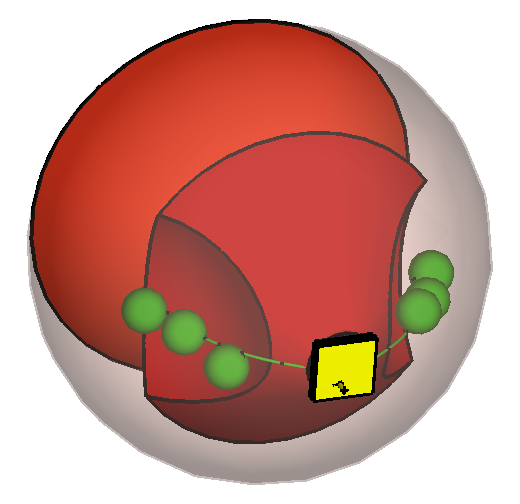
Healthy and malignant breast tissues do not interact with electromagnetic fields in the same way. Their different dielectric properties alter the electromagnetic loading seen by an antenna placed on the breast. This work uses that change as the sensing mechanism: keep the antenna and phantom configuration controlled, introduce early-stage tumor scenarios, and observe the shift in resonance and impedance matching.
The goal is not to create an anatomical image from MRI data. There is no BrainWeb, 3D Slicer or MeshLab workflow here. The breast phantom is a purpose-built electromagnetic model, simulated in CST; MATLAB is used in the analysis workflow, and the fabricated antenna is validated experimentally with a Rohde & Schwarz ZVB20 Vector Network Analyzer.
The phantom is a simplified hemispherical breast with a 75 mm radius. It includes skin, fat and muscle as the principal layers, while fibro-glandular tissue and lymph nodes are embedded inside the fat region. Three lymph nodes are modeled on each side of the fibro-glandular region, with ducts also represented. A flattened area at the nipple provides a repeatable mounting surface for the antenna.
This geometry allows the same sensor position to be maintained while tumor size and location are varied—so the resulting S11 changes can be compared against a healthy baseline.

The model explicitly separates tissue types by relative permittivity, conductivity and density. That contrast is fundamental to the sensing principle.
| Tissue | εr | σ (S/m) | ρ (kg/m³) |
|---|---|---|---|
| Skin | 37.9735 | 1.478 | 1100 |
| Fat | 5.14085 | 0.139 | 920 |
| Fibro-glandular | 57.2 | 1.99 | 1050 |
| Muscle | 52.668 | 1.773 | 1060 |
| Lymph node | 78 | 0.965 | 1050 |
| Tumor | 46.1 | 0.68 | 1050 |
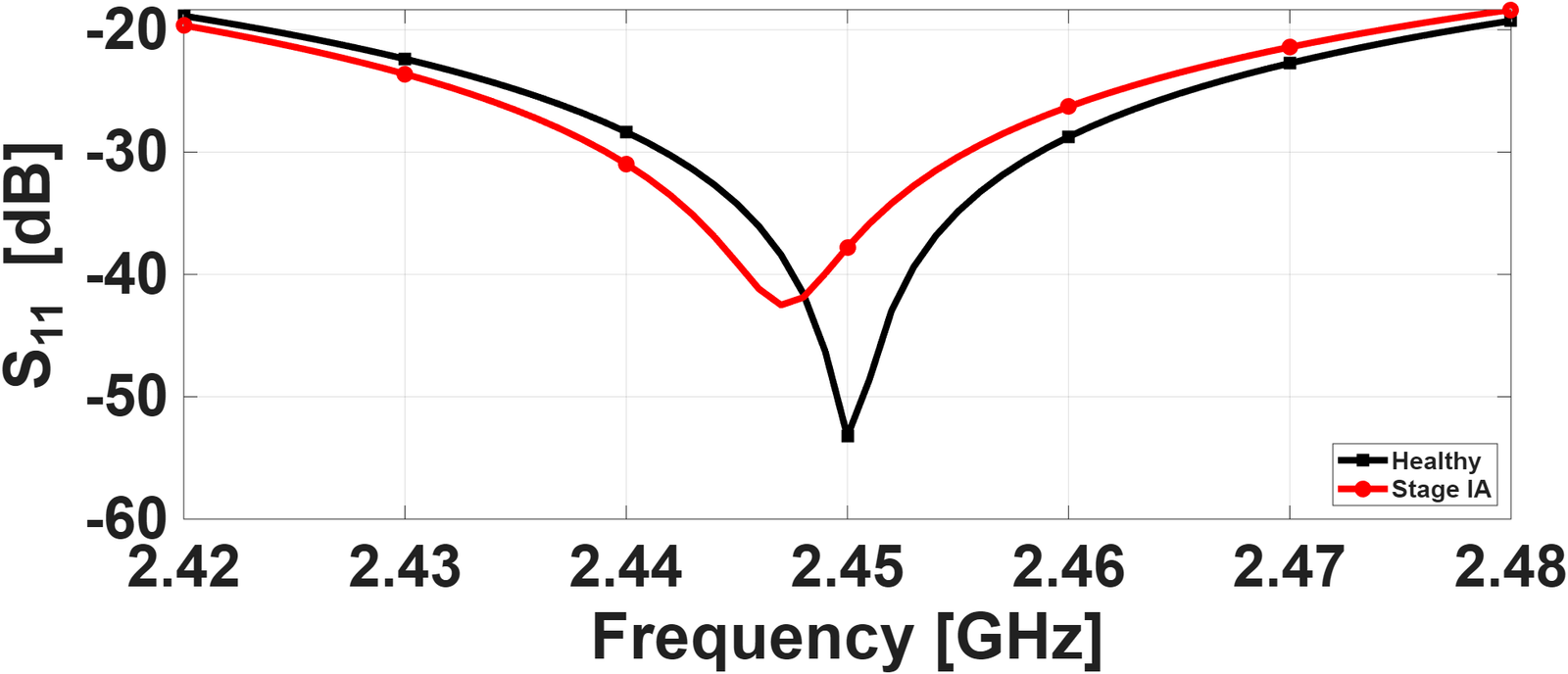
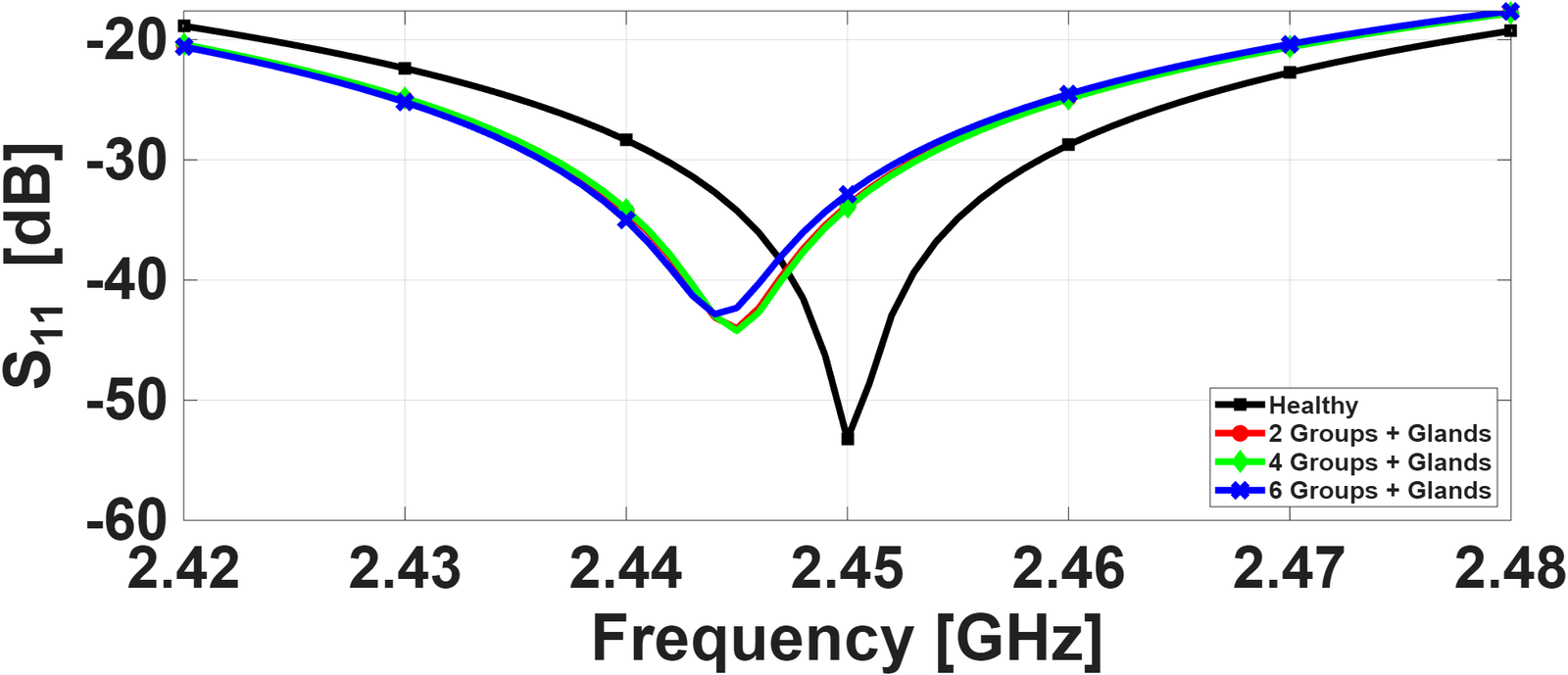
Stage IA is represented by a single tumor in the fibro-glandular region. Stage IB extends the investigation to lymph-node involvement: 2, 4 and 6 lymph-node groups are tested, both with and without an additional fibro-glandular tumor. Each scenario is compared to the same healthy breast response.

The sensor is not only a simulation. The rectangular spiral antenna was physically fabricated and characterized using a Rohde & Schwarz ZVB20 Vector Network Analyzer. The antenna uses annealed copper on Rogers 4350B, with a matching superstrate for protection and stability, and a 50 Ω coaxial feed.
The design targets the 2.4–2.5 GHz ISM band. Measurement provides a reality check against the simulated antenna response before the sensor is used as the diagnostic element in the breast-phantom study.
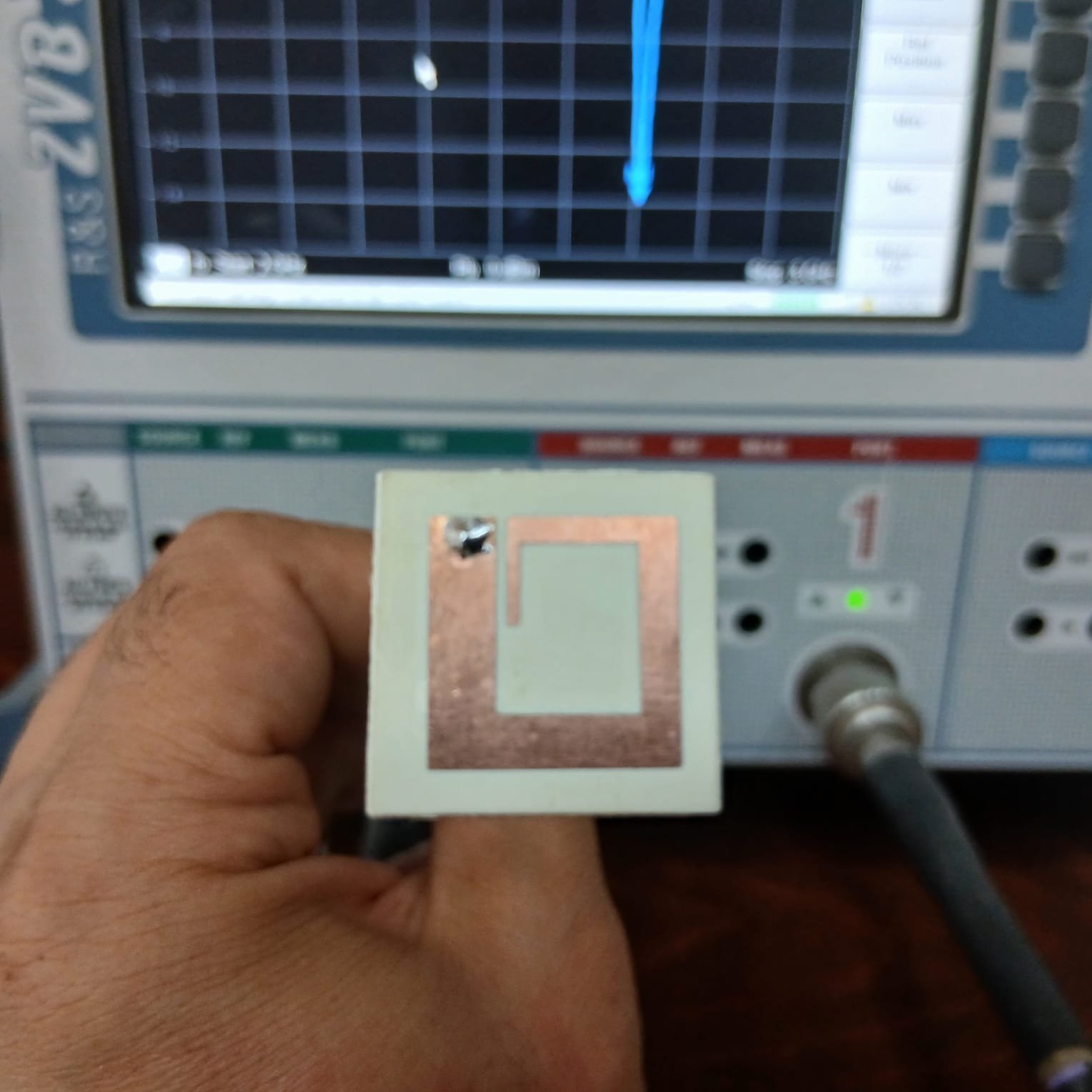


The planar spiral was selected for compact size and straightforward fabrication. In air, the design is optimized for good impedance matching in the ISM band. When mounted on the breast, the arm length and feed/shorting positions are retuned to compensate for the strong dielectric loading of tissue.
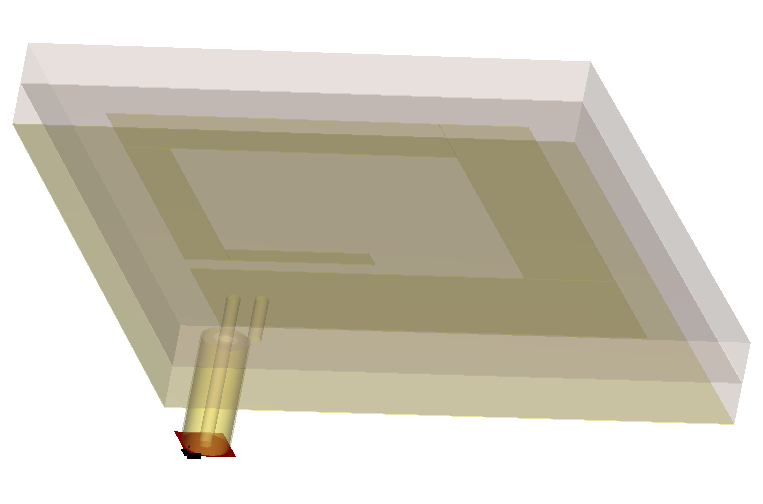
The fabricated antenna confirms a clear resonance in measurement. In the breast model, the healthy case resonates at 2.4500 GHz. Introducing the Stage IA tumor moves the resonance to 2.4470 GHz—a 3 MHz downward shift. Stage IB scenarios also remain below the healthy resonance, with shifts that depend on the number and location of tumors.

With the antenna implanted on the breast model, SAR was evaluated at 2.45 GHz and averaged over 10 g of tissue. The reported absolute maximum is 0.585 W/kg, concentrated near the antenna placement.

Design the rectangular spiral sensor and tune it for the 2.4–2.5 GHz ISM band.
Build the hemispherical tissue model, assign dielectric properties, lymph nodes, ducts and tumor scenarios.
Process and compare response data, inspect resonance movement, and prepare quantitative result visualizations.
Fabricate the sensor and measure S11 experimentally to validate the physical antenna response.
The work was presented at the 2025 8th International Conference on Digital Medicine and Image Processing (DMIP '25) in Tokyo. The presentation brought the antenna design, phantom methodology, tumor scenarios and measured/simulated electromagnetic response into a single research story.
Authors: Ismaeel M. Awad · Aya M. Hakik · Mohamad H. M. Hassanin · Pierre Louka · Mazen Nabil Desouky · Prof. Dr. A. M. M. A. Allam

The complete research paper and its GUC undergraduate-research cover page are available directly from this portfolio.
A research journey spanning electromagnetic modeling, antenna engineering, physical fabrication, VNA measurement, MATLAB analysis and international presentation.